

The Kapital · Global Deep Dive · United States · 20 August 2026
Nvidia has spent the AI boom selling the scarce asset everyone else needed. Now it is increasingly helping finance the infrastructure that will buy those chips. The newest example is extraordinary even by AI standards: Nvidia agreed to provide up to $105 billion of guarantees supporting OpenAI’s long-term lease of an Ohio data-center project developed by SoftBank-owned SB Energy. The arrangement can accelerate demand. It also changes the quality of that demand.
I have never thought Nvidia’s central risk was that artificial intelligence would suddenly disappear. The more interesting risk is financial architecture. A market can have real demand, real technological progress and real cash flows while still becoming fragile if suppliers, customers, landlords and financiers begin supporting one another in ways that blur where independent demand ends and ecosystem financing begins.
The Ohio deal does not prove that Nvidia’s growth is artificial. It does, however, force investors to ask a question that was much less important two years ago: if the leading chip supplier increasingly provides guarantees, equity investments and backstops around the same infrastructure that purchases its products, how much of future revenue should receive the same valuation multiple as straightforward cash-funded demand?
The size of the guarantee is the first thing I cannot ignore
Reuters reported on August 17 that Nvidia could provide up to $105 billion in guarantees connected to OpenAI’s 20-year lease of a data center in Pike County, Ohio. Nvidia is also investing $1.5 billion in SB Energy. The site is expected to reach as much as eight gigawatts of capacity, with about 800 megawatts targeted by 2028.
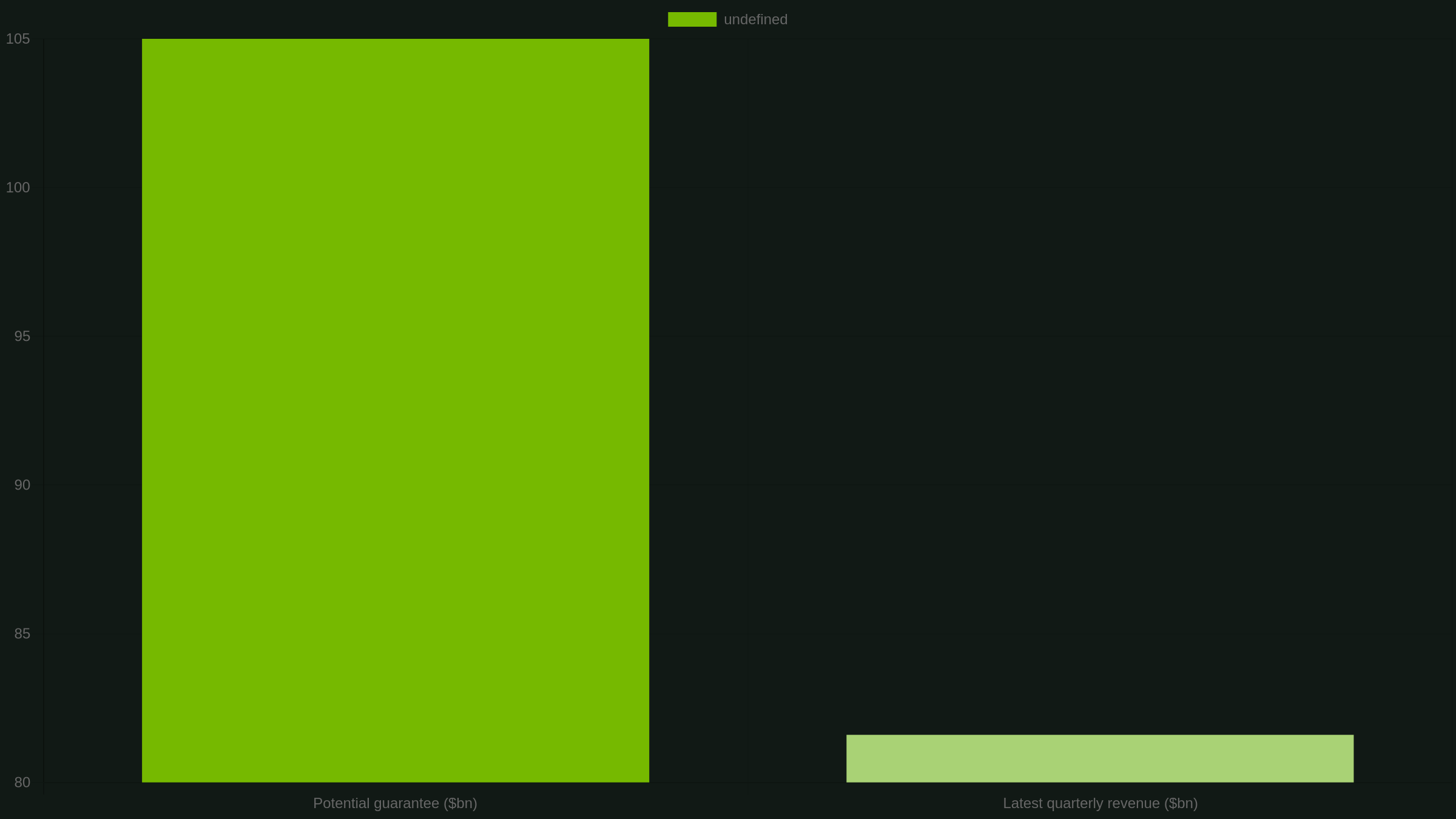
The number is startling because $105 billion exceeds Nvidia’s entire $81.6 billion revenue in its latest reported quarter. A guarantee is not the same thing as spending $105 billion today, and it would be wrong to treat the headline amount as an immediate cash outflow. Guarantees are contingent obligations. They become costly only under specific conditions. But contingent obligations matter precisely because investors tend to value them at almost zero during a boom and suddenly rediscover them during stress.
Nvidia can afford to play offense because the core business is extraordinary
The financing discussion only matters because Nvidia’s operating business remains so powerful. In the first quarter of fiscal 2027, revenue reached $81.6 billion, up 85 percent from a year earlier and 20 percent sequentially. Data Center revenue was $75.2 billion, up 92 percent year over year. GAAP operating income more than doubled to $53.5 billion, and gross margin was 74.9 percent.
Those are not the numbers of a company desperately manufacturing demand to survive. They are the numbers of a company with so much economic power that it can use its balance sheet to shape the market around itself.
That distinction is essential. Supplier financing is dangerous when it hides weak end demand. Nvidia’s current problem is different: demand is strong, but the scale of the infrastructure build has become so large that traditional customer balance sheets and project finance may no longer be sufficient to fund it at the desired speed.
Why financing customers can be strategically rational
There is a coherent industrial logic to what Nvidia is doing. AI infrastructure is constrained by power, land, transformers, networking, construction schedules and capital. If Nvidia waits for every customer to solve each bottleneck independently, GPU demand may be delayed even when ultimate compute demand exists.
By providing capital, guarantees or strategic partnerships, Nvidia can pull forward construction, standardize architectures and protect the ecosystem around its hardware. The company already benefits from a powerful software moat through CUDA and an expanding networking stack. Financing infrastructure can add another layer of control.
This is similar to what industrial companies have done for decades through vendor financing. Aircraft manufacturers, telecom equipment suppliers and machinery vendors have all helped customers fund purchases. The practice is not inherently suspicious. What matters is whether financed customers generate enough independent cash flow to repay the capital without relying on ever more financing from the same ecosystem.
The circular-financing problem
The concern becomes more serious when several loops overlap. Nvidia can invest in an infrastructure provider. That provider builds a data center for an AI customer. The customer signs a long lease. The data center buys Nvidia systems. Nvidia then benefits from revenue that exists partly because Nvidia helped make the financing possible.
Nothing in that chain is necessarily improper. The economic risk is duration mismatch. The chips are sold relatively early. The economic value that justifies the facility may take years to appear. If AI applications monetize slower than expected, the supplier has already recognized hardware demand while the ecosystem still carries long-lived obligations.
This is why I would separate three types of Nvidia demand in my valuation: cash-rich hyperscaler demand, externally financed but independently underwritten project demand, and demand materially supported by Nvidia’s own balance sheet. I do not value the third category at zero. I simply give it a higher risk discount.
Q1 FY27, $bn. Data Center represented roughly 92% of total quarterly revenue.
The guarantee also tells us something about the maturity of the AI cycle
Early in a capital cycle, the highest-return projects are usually funded first. Customers with obvious demand and abundant capital build aggressively. As the cycle expands, increasingly large projects need more complicated financial structures. That does not automatically mean the cycle is ending. It does mean capital intensity is moving from a side issue to a core part of the thesis.
The United States is already experiencing a huge increase in AI-related infrastructure financing. Data centers require not only accelerators but power generation, grid connections, cooling systems, real estate and debt capacity. Nvidia’s chips remain the highest-value component in many systems, but the return on the entire facility ultimately depends on utilization and the price customers will pay for compute.
I therefore watch GPU utilization, cloud AI pricing and customer free cash flow almost as closely as I watch benchmark performance. A faster chip is valuable. A faster chip in a half-empty data center is not economically equivalent.
Gross margins show how much room Nvidia has
Nvidia’s gross margin has recovered dramatically from the prior-year comparison and was 74.9 percent in Q1 FY27. That gives the company enormous capacity to absorb strategic spending while still producing extraordinary profits.
The risk for shareholders is not that one guarantee destroys Nvidia. The risk is that the company gradually needs to commit more balance-sheet capacity to sustain the growth rate on which its premium valuation depends. If that happens, the quality of each incremental dollar of revenue declines even if reported growth remains high.
What I would need to see before becoming worried
I would become meaningfully more cautious if Nvidia’s customer financing grows faster than revenue for several quarters, if major counterparties begin renegotiating leases, or if utilization data suggest infrastructure is being built materially ahead of demand. I would also watch receivables and cash conversion. When revenue growth is real and healthy, cash tends to confirm it.
Conversely, if OpenAI and other customers demonstrate strong monetization, high utilization and rising cash generation, these financing structures may look brilliant in hindsight. Nvidia could use a small portion of its enormous profit pool to accelerate an infrastructure layer that locks in years of demand.
My valuation framework after the guarantee
At roughly the mid-$200s recently, Nvidia is not priced like a semiconductor company. It is priced like the operating system and toll road of the AI economy. I think that premium is deserved, but it means the downside from a small change in perceived revenue quality can be larger than the downside from a small earnings miss.
Bear case: $155 to $175
In my bear case, AI infrastructure spending remains large but financing stress rises, customers become more selective and Nvidia needs to support more projects directly. Growth decelerates faster than expected and the market applies a lower multiple to long-duration earnings. I use about $165 as the center of this scenario.
Base case: $210 to $235
My base case assumes demand stays strong, Blackwell and subsequent platforms remain supply-constrained enough to protect margins, and Nvidia-backed financing remains a minority tool rather than the dominant source of demand. The Ohio project succeeds without meaningful guarantee losses. Around $220 is the center of my fair-value range.
Bull case: $275 to $300
The bull case requires the financing strategy to accelerate a genuinely productive AI economy. Compute utilization stays high, OpenAI and hyperscalers monetize capacity rapidly, and Nvidia’s networking, software and systems revenue deepen the moat. In that world, the company becomes more infrastructure platform than chip vendor.
Illustrative scenarios, not price targets. Recent price area refers to mid-August 2026 trading and can change quickly.
The hidden upside: Nvidia may be building a financing moat
There is a bullish interpretation that deserves more attention. If Nvidia becomes the one supplier capable of combining chips, networking, software, system design, strategic equity and financial support, then its moat becomes harder to attack. A competitor may build an excellent accelerator and still struggle to match the ecosystem’s ability to get a ten-billion-dollar facility financed, powered and deployed.
That would be a profound competitive advantage. It would also make Nvidia more complex. Investors would have to evaluate credit risk, project risk and counterparties alongside product cycles. Complexity itself deserves a discount because it makes earnings less transparent.
Why the next earnings report matters more than usual
The next earnings report will naturally focus on revenue and guidance. I will also look for language around financing commitments, strategic investments and customer concentration. The best outcome is simple: explosive demand continues while Nvidia’s contingent support remains small relative to operating cash generation.
I will pay special attention to whether management describes these structures as exceptional tools for bottleneck projects or as a repeatable model for the broader AI buildout. The first is easier to underwrite. The second could still create enormous value, but it moves Nvidia farther from the clean asset-light economics investors have rewarded.
Where the $105 billion guarantee leaves me
Nvidia’s $105 billion OpenAI-related guarantee is not evidence that the AI boom is fake. The company’s latest financial results are far too strong for that simplistic conclusion. Revenue is growing 85 percent, Data Center is growing 92 percent and gross margins remain near 75 percent.
What the guarantee does is change the question. Nvidia is no longer merely selling into the AI infrastructure boom. It is helping architect and finance it. That can extend the cycle and deepen the moat. It can also place contingent risk on Nvidia’s balance sheet and make the independence of future demand harder to judge.
At roughly $225, my base-case value is close to the market. I would not short this business because of one guarantee. I would also not ignore the financing architecture just because the income statement is currently spectacular. The next phase of the AI trade will be about return on capital, not merely the number of GPUs installed.
Sources and data status
Data status: 20 August 2026. The $105 billion figure is a maximum contingent guarantee, not an immediate cash outflow.
This article reflects my own analysis and is not investment advice. Guarantees, project-finance structures and equity valuations can change materially as contracts and market conditions evolve.