

Market capitalization is one of the simplest numbers in investing—and one of the easiest to misunderstand. Investors see a stock trading at $8 and call it “cheap.” They see another at $800 and assume it must be an enormous company. Neither conclusion follows from the share price alone.
Market capitalization, usually shortened to market cap, solves that problem by combining the share price with the number of shares investors actually own. It measures the market value of a company’s outstanding equity at a specific point in time.
The formula is simple:
Market Capitalization = Share Price × Shares Outstanding
That simplicity hides several important questions. Which share count should you use? What happens after a stock split? Why can a company’s market cap rise even when the business raises no new cash? How do dilution and buybacks change the number? And why is market cap the wrong numerator when comparing companies with very different debt and cash balances?
This guide answers those questions and shows why market cap is best understood as the market’s current price for the equity—not as a complete measure of what the operating business is worth.
What is market capitalization?
Investor.gov defines market capitalization as the value of a corporation obtained by multiplying the current market price of one share by the total number of outstanding shares.
If a company has 500 million shares outstanding and each share trades at $40, the market cap is:
500 million × $40 = $20 billion
That $20 billion is the market value of the equity. It is the aggregate value that public-market investors currently assign to all outstanding shares.
Market cap changes continuously during trading because the share price changes. It can also change when the share count changes through new issuance, employee compensation, conversions, acquisitions, buybacks or other corporate actions.
Why share price alone tells you almost nothing
Consider two hypothetical companies:
- Company A: share price $10, 5 billion shares outstanding;
- Company B: share price $500, 20 million shares outstanding.
Company A has a market cap of $50 billion. Company B has a market cap of only $10 billion.
The $10 stock is therefore five times larger by equity market value than the $500 stock.
This is the first rule of market cap: a low share price does not make a company small or cheap, and a high share price does not make a company large or expensive.
Valuation requires a denominator such as earnings, cash flow, sales or book value. Market cap by itself measures size, not cheapness.
A visual example: same share price, radically different market cap
Market cap is equity value, not enterprise value
One of the most important distinctions in valuation is the difference between equity value and enterprise value.
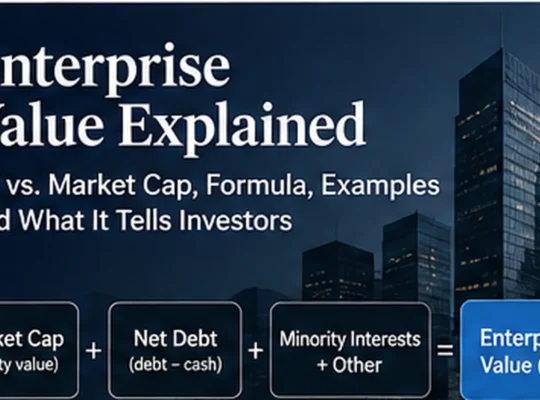
Market cap values the common equity. Enterprise value attempts to measure the value of the operating business available to all capital providers, adjusting for debt and cash.
A simplified enterprise-value formula is:
Enterprise Value ≈ Market Cap + Debt − Cash
Additional adjustments may be needed for preferred stock, minority interests and other claims.
Imagine two companies with identical $20 billion market caps. Company X has $1 billion of debt and $8 billion of cash. Company Y has $15 billion of debt and $1 billion of cash. Their equity values are the same, but the capital structures are not remotely comparable.
That is why ratios such as EV/EBITDA use enterprise value rather than market cap. Our Enterprise Value Explained guide covers this distinction in detail.
Market cap does not equal the cost of buying the whole company
A common shortcut says market cap is “what it would cost to buy the company.” That is not quite right.
An acquirer trying to purchase 100% of a public company would usually have to offer a premium to the unaffected trading price to persuade shareholders to sell. The buyer would also inherit or refinance debt and gain access to the target’s cash and other assets.
The transaction value can therefore differ materially from the quoted market cap.
Market cap is better described as the public market’s current aggregate price for the outstanding equity at the marginal trading price.
Outstanding shares versus authorized shares
Companies can have several different share-count concepts:
- authorized shares: the maximum number the corporate charter permits;
- issued shares: shares the company has issued;
- treasury shares: previously issued shares repurchased and held by the company;
- outstanding shares: issued shares currently held by investors, excluding treasury shares.
Market capitalization normally uses outstanding shares.
For valuation, investors should also understand the diluted share count, which considers securities that may become common shares under specified conditions. Options, restricted stock units, convertible securities and other claims can increase the economic share count over time.
Basic market cap versus fully diluted equity value
Suppose a company has 100 million common shares outstanding at $30. Its basic market cap is $3 billion.
But assume employees hold 10 million economically valuable options or restricted units and a convertible security could create another 15 million shares. A fully diluted valuation may need to recognize much more than the headline 100 million shares.
This matters most in companies that compensate employees heavily with stock or finance themselves through convertible instruments.
Our Share Dilution Explained guide shows why rising share counts can reduce each investor’s ownership even when the business itself grows.
How new share issuance changes market cap
If a company issues new shares for cash, the share count rises. But the market cap does not mechanically rise by the exact amount of cash raised because the stock price can move at the same time.
For example, a company with 100 million shares at $20 has a $2 billion market cap. It issues 10 million new shares at $18, raising $180 million. Immediately afterward there are 110 million shares, but the trading price may adjust based on the terms, use of proceeds and information embedded in the transaction.
The economic question is whether the capital raised creates more value per share than the dilution imposed on existing owners.
How buybacks affect market cap
A share repurchase reduces shares outstanding if the repurchased stock is retired or held as treasury stock. Fewer shares can raise earnings per share even if total net income does not change.
But buybacks do not create value automatically.
If a company repurchases shares below intrinsic value, continuing shareholders can benefit because the company acquires its own equity cheaply. If it repurchases dramatically overvalued shares, value can be destroyed even as EPS rises.
This is why share-count trends should be analyzed together with valuation and return on invested capital.
Stock splits do not change market cap by themselves
A stock split changes the number of shares and the price per share proportionally.
In a 10-for-1 split, an investor who owned one $1,000 share may end up with ten shares worth roughly $100 each immediately after the mechanical adjustment.
The market cap is unchanged:
old price × old shares = new price × new shares
A pizza cut into more slices is still the same pizza.
Market prices can move after a split because investor demand and expectations change, but the split itself creates no fundamental equity value.
Why market cap matters for index weighting
Many major stock indexes are market-cap weighted or float-adjusted market-cap weighted.
Investor.gov notes that market-cap-weighted indexes assign larger weights to companies with greater market capitalization. If one constituent doubles in market value while everything else stays constant, its index influence rises.
This has an important portfolio consequence: buying a market-cap-weighted index is not the same as allocating equal amounts to every company. More investor capital is automatically directed toward the companies the market already values most highly.
Our ETF vs. Index Fund guide explains how benchmark design affects passive portfolios.
Float-adjusted market capitalization
Some index providers do not use every outstanding share. They use free float: shares considered available for public trading.
Large strategic holdings controlled by founders, governments, parent companies or other insiders may be excluded or partially adjusted.
This can make a company’s investable market capitalization smaller than its headline market cap.
For index investors, this distinction matters because index weights can be based on float-adjusted value rather than total equity value.
Large cap, mid cap and small cap
Investors often classify companies as large-cap, mid-cap or small-cap. Investor.gov describes these labels as terms used to categorize company size and market value.
The exact numerical boundaries vary across index providers, brokers and market cycles. A threshold that once defined a large company can become outdated as the overall market grows.
The labels are therefore useful categories, not immutable laws.
In general, smaller companies may offer more growth optionality but often carry greater liquidity, financing and business-model risk. Large companies tend to have deeper markets and more established operations, but size alone says nothing about future returns.
Market cap and valuation multiples
Market cap becomes much more useful when compared with an equity-level fundamental.
Examples include:
- P/E: market cap relative to net income;
- Price-to-book: market cap relative to common equity book value;
- Price-to-sales: market cap relative to revenue;
- Free-cash-flow yield: equity free cash flow relative to market cap.
Our guides to Price-to-Book, Price-to-Sales and Free Cash Flow Yield show how the same market cap can look cheap or expensive depending on the economics underneath it.
Market cap versus book value
Market cap is determined by investors in the market. Book value is an accounting measure derived from the balance sheet.
If a company has $10 billion of common equity on its balance sheet and a $30 billion market cap, it trades at roughly three times book value.
That premium can reflect valuable intangible assets, high expected returns on capital, future growth or simply excessive optimism.
For banks and some asset-heavy businesses, book value can be economically meaningful. For software or brand-driven companies, accounting book value often omits much of the internally created economic asset base.
Market cap versus revenue
A company can have a $50 billion market cap with $5 billion of sales or $100 billion of sales. Revenue alone does not determine equity value.
Margins, growth, reinvestment needs, capital intensity, competitive advantage and risk determine how much investors are willing to pay for each dollar of revenue.
This is why the gross margin and operating margin matter when comparing companies with similar market caps.
Why market cap can rise without the company receiving cash
If a stock rises from $20 to $30, the company does not receive the $10 difference per share. The market cap rises because investors are willing to exchange shares at a higher price.
Primary capital raising happens when the company itself issues securities. Secondary-market trading happens between investors.
This distinction is crucial. A $10 billion increase in market cap is not $10 billion of new cash on the company’s balance sheet.
Why market cap can fall faster than fundamentals
Market capitalization is a price-based measure. Expectations can change far faster than reported revenue, earnings or assets.
A company may report only a small decline in earnings while its market cap falls 40% because investors revise expectations for future growth, margins or risk.
The reverse also happens. Market cap can surge before financial statements show major improvement because markets discount future outcomes.
Market cap and intrinsic value are different concepts
Market cap tells you what the market currently charges for the equity. Intrinsic value is an analytical estimate of what that equity is economically worth.
The gap between the two is the foundation of active investing.
If an analyst estimates intrinsic equity value at $30 billion while the market cap is $20 billion, the stock may appear undervalued. But the conclusion is only as good as the assumptions behind the valuation.
Our Intrinsic Value Explained guide develops this idea in detail.
Market cap and the share-price trap
Penny stocks provide the clearest example of why share price is misleading.
A stock trading at $0.50 can still have a multi-billion-dollar market cap if billions of shares exist. Conversely, a company can trade at several thousand dollars per share and still be smaller if very few shares are outstanding.
Investors should therefore remove the phrase “cheap stock price” from their analytical vocabulary unless “cheap” refers to valuation relative to fundamentals.
Five market-cap mistakes investors make
1. Comparing share prices instead of market caps
Share count makes raw prices incomparable across companies.
2. Using market cap where enterprise value belongs
Operating metrics such as EBITDA should generally be compared with a capital-structure-neutral valuation measure.
3. Ignoring dilution
A basic share count can understate the claims on future equity value.
4. Treating market cap as cash in the company
Secondary-market appreciation does not deposit money on the corporate balance sheet.
5. Assuming larger means safer
Size can improve liquidity and financing access, but large companies can still be overleveraged, disrupted or overvalued.
A practical investor checklist
- Confirm the current share price.
- Use the correct outstanding share count.
- Review diluted securities and stock compensation.
- Check whether the relevant index uses float-adjusted market cap.
- Compare market cap with enterprise value.
- Match valuation denominators correctly: equity metrics with equity value, enterprise metrics with enterprise value.
- Review the share-count trend over several years.
- Separate stock splits from real economic value creation.
- Do not infer cheapness from share price.
- Compare market cap with an estimate of intrinsic value rather than treating market price as value by definition.
Market capitalization FAQ
How do you calculate market cap?
Multiply the current share price by the number of outstanding shares.
Is market cap the same as company value?
It is the market value of common equity. It does not by itself account for debt, cash and other claims, so it is not the same as enterprise value.
Does a stock split change market cap?
Not mechanically. The share count and price adjust in opposite directions.
Is a $5 stock cheaper than a $500 stock?
No. Share price alone says nothing about valuation. You need share count and business fundamentals.
Why does market cap matter in index funds?
Many indexes weight companies by market capitalization or float-adjusted market capitalization, so larger companies receive larger weights.
Can market cap change without issuing shares?
Yes. It changes whenever the stock price changes.
The bottom line
Market capitalization is simple arithmetic with profound implications. It converts an arbitrary-looking per-share price into the aggregate market value of the equity.
Used correctly, market cap helps investors compare company size, understand index weights, analyze dilution and choose the right valuation framework. Used carelessly, it creates some of the most persistent mistakes in investing—especially the belief that a low-priced share must be cheap.
The market cap is the price investors collectively assign to the equity today. Whether that price is attractive is a different question. That question belongs to valuation.
Sources
- Investor.gov — Market Capitalization
- Investor.gov — Large Cap, Mid Cap, Small Cap
- Investor.gov — Index Funds and Market-Cap Weighting
- CFA Institute — Equity Valuation: Concepts and Basic Tools
This article is educational information and does not constitute individualized investment advice.