

Intrinsic value is the idea behind almost every serious attempt to answer the question: what is this investment actually worth? Market price tells you what buyers and sellers agree on today. Intrinsic value is an estimate of the economic value justified by the cash flows, assets, growth prospects and risks of the business.
That distinction is the foundation of active investing. If price and value were always identical, valuation would be pointless. The entire exercise exists because investors believe a security can trade above or below a reasonable estimate of fundamental value.
But intrinsic value is not a secret number hidden inside a company. It is an estimate. Different analysts can study the same business, use defensible assumptions and still produce different valuations.
This guide explains the main intrinsic-value methods, why discounted cash flow is so important, how discount rates and terminal values affect the result, why margin of safety matters, and why the best valuation work usually produces a range rather than one perfectly precise number.
What is intrinsic value?
CFA Institute describes intrinsic value as a value estimate based on the fundamentals and investment characteristics of a security. In practical terms, it is an analyst’s estimate of what an asset is economically worth given its expected future benefits and risks.
Aswath Damodaran frames intrinsic valuation around three variables: cash flows, growth and risk. In a discounted cash flow model, the value of an asset is the present value of expected future cash flows discounted at a rate reflecting their risk.
The key point is simple:
Intrinsic value comes from the economics of the asset, not from the quoted market price.
Price and value are not the same thing
A stock price is observable. Intrinsic value is not.
If a stock trades at $50, everyone can see that price. Whether the stock is worth $35, $50 or $80 depends on forecasts about the future.
An investor estimating value must form views on:
- future revenue and margins;
- cash conversion;
- reinvestment needs;
- competitive advantage;
- capital structure;
- risk;
- growth duration;
- the appropriate discount rate;
- the terminal economics of the business.
Intrinsic value therefore depends on assumptions. Good valuation does not eliminate uncertainty. It makes uncertainty explicit.
The three broad ways to estimate intrinsic value
CFA Institute groups common equity valuation approaches into three broad categories:
- present-value models;
- multiplier or relative-value models;
- asset-based models.
Each is useful in different situations.
Present-value models are the purest form of intrinsic valuation because they estimate value from future economic benefits. Multiples infer value from comparable assets. Asset-based methods focus on the value of assets minus liabilities.
A strong analyst usually chooses the method that fits the business rather than forcing every company into the same spreadsheet.
Discounted cash flow: the core intrinsic-value model
The general DCF idea is:
Intrinsic Value = Present Value of Expected Future Cash Flows
A future dollar is worth less than a dollar today because capital has an opportunity cost and future cash flows are uncertain. DCF therefore discounts future cash flows back to the present.
The simplified structure is:
Value = CF₁/(1+r) + CF₂/(1+r)² + … + Terminal Value/(1+r)ⁿ
where r is the discount rate.
Our DCF Valuation Explained guide covers the mechanics in greater detail.
Equity value versus enterprise value in DCF
There are two common DCF routes.
FCFF approach
Free cash flow to the firm is cash flow available to both debt and equity capital providers. It is discounted using a weighted average cost of capital. The result is enterprise value. Debt and other claims are then adjusted to reach equity value.
FCFE approach
Free cash flow to equity is cash flow available specifically to common shareholders after financing effects. It is discounted at the cost of equity and produces equity value directly.
Mixing enterprise cash flows with an equity discount rate—or equity cash flows with WACC—is a structural valuation error.
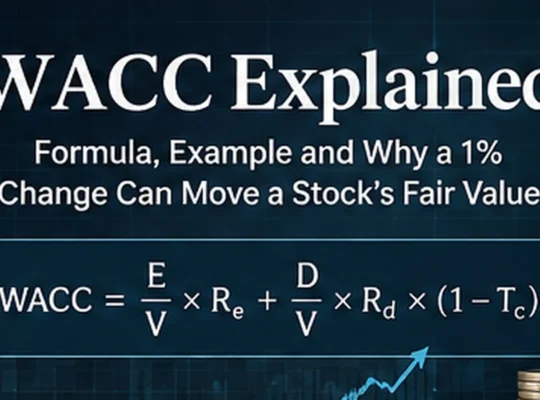
Our WACC Explained article shows why the discount rate must match the cash flow being valued.
Why free cash flow matters
Accounting earnings are important, but owners ultimately benefit from cash that can be distributed or reinvested at attractive rates.
Two companies can report the same net income while having very different cash economics because of capital expenditure, working capital, stock compensation or accounting choices.
This is why analysts often focus on free cash flow when estimating intrinsic value.
Our Free Cash Flow vs. Net Income guide explains why earnings quality matters before a valuation model is built.
Growth does not create value by itself
A common valuation mistake is assuming more growth always means more value.
Growth creates value only when the company can reinvest capital at returns above the opportunity cost of that capital.
If a company invests $100 and earns only $5 of sustainable operating profit when investors require a return closer to 10%, growth can destroy value.
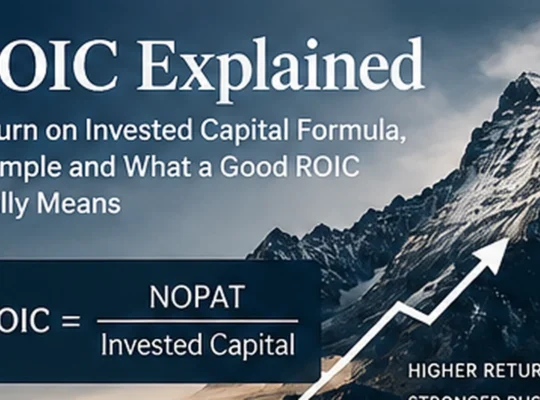
That is why return on invested capital belongs at the center of intrinsic-value analysis.
The most valuable growth businesses combine large reinvestment opportunities with high incremental returns on capital.
A simple intrinsic-value example
Assume a hypothetical business generates $100 million of free cash flow today. An analyst expects cash flow to grow for several years before converging toward a mature rate.
At a lower discount rate and stronger long-run growth assumption, the present value can be high. At a higher discount rate or weaker terminal growth rate, the result falls materially.
This sensitivity is not a flaw in DCF. It reveals an economic truth: the value of a long-duration business depends heavily on assumptions about the distant future.
Intrinsic value is usually a range, not a point estimate
Suppose three reasonable scenarios produce values of $42, $58 and $76 per share. Reporting $58.13 as “the” intrinsic value creates false precision.
The better conclusion is that the stock appears worth roughly $40–$75 under the chosen assumptions, with the center of the range around the high $50s.
The wider the range, the more uncertain the business or valuation inputs are.
The terminal value problem
In many DCF models, a large percentage of total value comes from the terminal value—the value assigned to cash flows beyond the explicit forecast period.
This can make a model extremely sensitive to small changes in long-term assumptions.
A terminal growth rate that rises from 2% to 3% may change the valuation substantially. So can a 1-percentage-point change in WACC.
Analysts should therefore ask:
- Is the terminal growth rate plausible relative to the economy?
- Are terminal margins sustainable?
- Does the terminal return on capital make economic sense?
- Is the discount rate consistent with mature business risk?
A terminal value is not a plug designed to make the spreadsheet match the market price.
Discount rate sensitivity
The discount rate is one of the most powerful variables in intrinsic valuation.
Higher discount rates reduce present value. Lower discount rates increase it.
For companies whose cash flows lie far in the future, this effect is especially strong. Long-duration growth stocks can therefore experience major valuation compression when required returns rise even if near-term earnings remain healthy.
This is the economic link between interest rates, risk premiums and equity valuation.
Dividend discount models
For mature companies that distribute a stable portion of earnings to shareholders, dividends can be used as the cash flow in a present-value model.
The Gordon growth model is the simplest form:
Value = D₁ / (r − g)
where D₁ is next period’s dividend, r is the required return and g is the long-run dividend growth rate.
The model is elegant but extremely sensitive when r and g are close. It is not suitable for every company, especially firms with unstable payout policies or large reinvestment opportunities.
Owner earnings
Some investors think in terms of “owner earnings”: the cash that could theoretically be taken out of the business without damaging its competitive position.
The concept tries to adjust accounting profit for non-cash charges and the capital spending required to maintain the business.
The practical difficulty is separating maintenance investment from growth investment. Companies rarely provide a clean line item for that distinction.
Owner earnings is therefore conceptually useful but still requires judgment.
Relative valuation is not the same as intrinsic valuation
If a stock trades at 15 times earnings and peers trade at 25 times, the stock may appear cheap on a relative basis.
But relative cheapness does not prove intrinsic undervaluation.
The entire peer group may be overvalued. Or the lower multiple may be justified by weaker growth, margins, balance-sheet quality or competitive position.
Multiples are powerful because they are fast and market-aware. DCF is powerful because it forces explicit assumptions. Strong analysis often uses both.
Our P/E Ratio, Price-to-Book and Price-to-Sales guides explain the major relative-valuation tools.
Asset-based intrinsic value
Some businesses are better valued through their assets than through near-term earnings.
Examples can include investment holding companies, certain real-estate businesses, banks, insurers and businesses in liquidation or restructuring.
The basic concept is:
Estimated Asset Value − Estimated Liabilities = Estimated Equity Value
But book values may not equal economic values. Real estate may be carried at historical cost. Intangible assets may be missing. Troubled assets may be worth far less than accounting values.
Asset-based valuation therefore requires economic adjustments, not blind reliance on the balance sheet.
Intrinsic value for banks is different
For banks, debt is closer to an operating input than a normal financing decision. Enterprise-value models can become awkward.
Analysts often focus on equity-level measures such as book value, tangible book value, return on equity and dividend or residual-income models.
This is a reminder that valuation methods must fit the business model.
Intrinsic value for high-growth companies
Young growth companies create a different problem. Current cash flow may be low or negative because the business is investing aggressively.
A valuation then depends on forecasts of future market size, margins, capital intensity and competitive durability.
The farther the model reaches into the future before meaningful cash generation begins, the wider the uncertainty range should be.
A precise target price based on ten years of speculative assumptions is usually less reliable than it looks.
Intrinsic value for cyclical businesses
Cyclical companies can look cheapest near peak earnings and most expensive near trough earnings.
Using one year of unusually high commodity prices or margins can produce a wildly inflated intrinsic value.
Analysts should normalize earnings, margins and reinvestment over a cycle rather than extrapolate peak conditions indefinitely.
Margin of safety
Margin of safety is the gap an investor demands between market price and estimated intrinsic value.
If a stock trades at $50 and the analyst’s base-case value is $55, the upside may be too small to compensate for estimation error.
If the same stock trades at $35 against a defensible value range of $50–$65, the margin of safety is much larger.
The purpose is not to guarantee profit. It is to acknowledge that valuation models are wrong.
The more uncertain the business, the larger the margin of safety an investor may reasonably require.
Why quality deserves a different valuation
Two companies with identical current earnings can have very different intrinsic values.
A business with recurring revenue, strong pricing power, high incremental returns on capital and a long reinvestment runway deserves a different valuation from a commodity producer earning the same profit at the top of a cycle.
Intrinsic value depends on the duration and quality of cash flows, not merely their current size.
This is why our Gross Margin and Operating Margin guides focus on business economics rather than isolated accounting ratios.
Why balance-sheet risk changes intrinsic value
A highly leveraged company can have attractive operating assets but fragile equity value.
Debt holders have priority claims. Small changes in enterprise value can therefore create much larger percentage changes in the residual value available to common shareholders.
This is another reason market cap alone is not enough. Investors need to understand the entire capital structure.
Our Enterprise Value guide shows how debt and cash alter the bridge from operating value to equity value.
Why a valuation can be right and the investment still lose money
An analyst can estimate long-run value reasonably well and still lose money if:
- the thesis takes much longer to play out than expected;
- new information changes the business;
- the market never closes the gap;
- the investor is forced to sell during a drawdown;
- the discount rate changes materially;
- management allocates capital badly.
Valuation is necessary for many active strategies, but it is not a timing tool.
Reverse DCF: asking what the market price assumes
Instead of forecasting value directly, a reverse DCF starts with the current price and asks what assumptions are required to justify it.
For example, if the market price implies 20% annual free-cash-flow growth for a decade, the investor can judge whether that expectation is realistic.
This approach is often more robust because it turns the valuation problem into an expectations problem.
The key question becomes: what must be true for today’s price to make sense?
Scenario analysis beats false precision
A useful intrinsic-value model should normally include at least:
- a downside case;
- a base case;
- an upside case;
- a sensitivity table or chart for major assumptions.
For a growth company, the key variables might be revenue growth, terminal margin and discount rate. For a bank, they might be return on equity and cost of equity. For a commodity company, they might be normalized prices and production costs.
The goal is to understand what drives value—not to hide uncertainty behind decimals.
Common intrinsic-value mistakes
1. Using one precise target
A single number disguises uncertainty.
2. Forecasting recent growth forever
Competition and market saturation eventually matter.
3. Choosing the discount rate to get the desired answer
The discount rate should reflect risk, not the analyst’s target price.
4. Ignoring dilution
Enterprise value can grow while value per share disappoints if the share count rises substantially.
5. Using peak margins as terminal margins
Temporary economics should not be capitalized forever.
6. Treating multiples as proof of intrinsic value
Relative cheapness is not the same as absolute cheapness.
7. Ignoring reinvestment
Growth requires capital. Growth assumptions must be consistent with reinvestment needs and return on capital.
A practical intrinsic-value workflow
- Understand the business model. Identify the true economic drivers.
- Normalize the starting numbers. Remove obvious one-offs and cyclical extremes.
- Forecast revenue, margins and reinvestment. Make assumptions internally consistent.
- Estimate free cash flow. Match cash-flow definition to the valuation framework.
- Choose the discount rate. Reflect business and financial risk.
- Build a terminal assumption. Use mature economics, not heroic extrapolation.
- Bridge to equity value. Adjust debt, cash and other claims correctly.
- Divide by diluted shares. Use a realistic per-share denominator.
- Run scenarios. Test growth, margins and discount rates.
- Demand a margin of safety. Treat the model as an estimate, not a fact.
Intrinsic value FAQ
What is intrinsic value?
It is an estimate of an asset’s economic value based on fundamentals, expected future benefits and risk rather than simply its current market price.
How do you calculate intrinsic value?
Common methods include discounted cash flow, dividend discount models, asset-based valuation and, more indirectly, valuation multiples.
Is DCF the same as intrinsic value?
DCF is one major method for estimating intrinsic value. Intrinsic value is the broader concept.
What is margin of safety?
It is the discount between market price and estimated value that an investor requires to compensate for uncertainty and analytical error.
Why do analysts get different intrinsic values?
They use different assumptions about growth, margins, reinvestment, risk, discount rates and terminal economics.
Can intrinsic value be known exactly?
No. It is an estimate. Good valuation makes uncertainty visible through ranges and scenarios.
The bottom line
Intrinsic value is not a magic number. It is a disciplined estimate of what an asset is worth based on the cash it can generate, the capital it must reinvest, the risk investors bear and the economics it can sustain.
The best valuation work does not eliminate uncertainty; it organizes it. A strong model shows which assumptions matter, how wide the reasonable range is and how much margin of safety exists at the current market price.
The most dangerous valuation is often not the one with rough assumptions. It is the one that looks perfectly precise.
Sources
- CFA Institute — Equity Valuation: Concepts and Basic Tools
- CFA Institute — Equity Valuation: Applications and Processes
- CFA Institute — Free Cash Flow Valuation
- Aswath Damodaran, NYU Stern — Intrinsic vs. Relative Valuation
- Aswath Damodaran, NYU Stern — An Introduction to Valuation
This article is educational information and does not constitute individualized investment advice.