
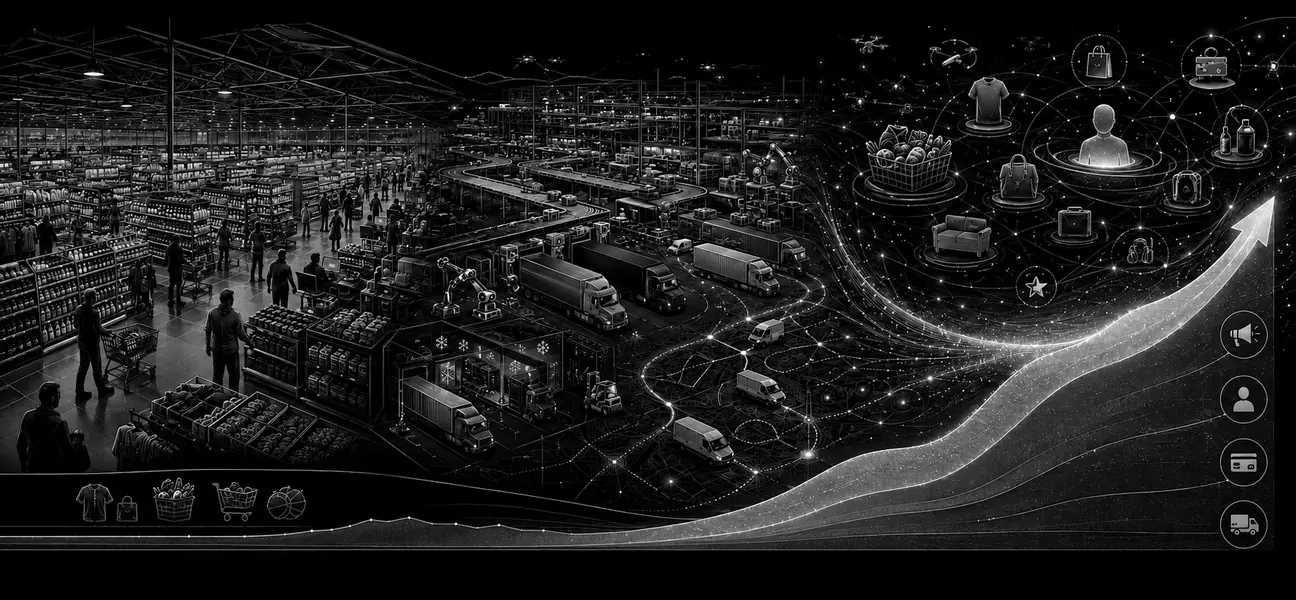
A Walmart store is designed to make complexity disappear. The milk is cold, the shelves are full, the app knows which aisle holds the batteries, and a bag can arrive at a customer’s door before the machinery behind that promise becomes visible. But when I look at Walmart’s latest quarter, I no longer see only a retailer hiding logistics behind fluorescent light. I see a distribution network learning to sell three increasingly valuable things at once: merchandise, access and attention.
The merchandise business remains immense and low-margin. Access is sold through membership, marketplace services and fast delivery. Attention is sold through advertising, where a retailer can connect an ad to an actual purchase with unusual precision. The stores, once treated by investors as expensive physical baggage, have become local fulfillment nodes that make all three layers stronger.
Fiscal Q2 2027 reinforced that transformation. Global e-commerce sales grew 23%. Walmart U.S. e-commerce rose 24%, store-fulfilled delivery grew 40% and marketplace net sales increased more than 50%. Global advertising revenue grew 38%, while Walmart Connect in the United States grew 43% excluding Vizio. Membership fee revenue increased 17%.
These are not side projects anymore. Walmart U.S. e-commerce represents roughly 23% of segment sales. Yet the stock market has noticed. At about $104.34 per share, Walmart carried a market capitalization near $834.6 billion and traded around 36.6 times trailing earnings. My Walmart stock analysis therefore arrives at a paradox: the business is becoming better in exactly the way bulls hoped, while the valuation increasingly leaves little room for the ordinary disappointments that even excellent retailers experience.
The quarter in one view
| Q2 FY2027 metric | Result | What it says |
|---|---|---|
| Total revenue growth | +5.9%; +5.1% constant currency | Scale growth remains solid rather than spectacular. |
| Walmart U.S. comparable sales | +2.6% excluding fuel | The domestic core is growing, but not fast enough alone to justify a premium technology multiple. |
| Sam’s Club U.S. comparable sales | +4.4% excluding fuel | Membership and digital engagement support stronger momentum. |
| Global e-commerce | +23% | The digital channel is materially outgrowing the company. |
| Global advertising | +38% | A high-margin layer is scaling on top of retail traffic. |
| Adjusted operating income | +17.4% constant currency | Includes a substantial, non-recurring tariff-refund benefit. |
| First-half operating cash flow | $19.7bn | The network continues to generate enormous cash. |
| First-half free cash flow | $5.5bn | Investment needs and working capital absorb much of operating cash. |
The revenue result is easy to underestimate because Walmart’s denominator is enormous. A little over 5% constant-currency growth on a global revenue base measured in hundreds of billions creates more incremental sales than many admired consumer companies generate in total. But the investor’s task is not to applaud scale. It is to determine whether each new dollar is becoming more valuable.
The chart shows why the earnings story is migrating away from the checkout lane. Every digital or service layer grew much faster than comparable-store sales. The critical question is not whether these activities are growing. It is whether their economics can become large enough to alter Walmart’s consolidated margin profile.
The store has become a server with a parking lot
E-commerce once appeared to turn Walmart’s strongest asset—its store estate—into a liability. Amazon could centralize inventory in purpose-built fulfillment centers while Walmart paid to light, staff and maintain thousands of buildings. That interpretation was too static. A store close to the customer can serve as showroom, warehouse, pickup point, returns desk and last-mile dispatch center. The same inventory can answer both a person pushing a cart and an algorithm routing an order.
Store-fulfilled delivery grew 40% in the quarter. That figure matters because speed is partly a geography problem. Walmart has spent decades placing inventory near the American population. It does not need to build an entirely separate network to make every digital sale possible; it needs to improve picking, inventory accuracy, automation and route density inside the network it already owns.
This creates a local flywheel. More digital volume increases the density of delivery routes. Denser routes can lower the cost per order. Faster and more reliable delivery makes membership more useful. Membership raises shopping frequency and gives Walmart richer first-party data. That data improves advertising, which subsidizes the economics of commerce. The circle is more important than any isolated growth rate.
I would still resist calling Walmart a technology company. Labels can seduce investors into applying the wrong multiples. It remains a retailer with perishables, shrink, labor, inventory risk and price-sensitive customers. The better description is that Walmart is becoming a technology-amplified retailer, using digital services to make a historically thin-margin asset base more productive.
Marketplace: selling the shelf without owning the goods
Marketplace net sales grew more than 50%. The appeal is straightforward: third-party sellers expand assortment while carrying much of the inventory risk. Walmart can earn referral, fulfillment and advertising fees without buying every product that appears on the digital shelf. In physical retail, assortment is limited by square footage. In a marketplace, the shelf becomes nearly infinite.
The strategic value goes beyond fee revenue. A broader catalogue gives shoppers fewer reasons to begin elsewhere. More shoppers attract more sellers. More sellers create more advertising demand. Fulfillment services deepen seller dependence on Walmart’s network. This resembles part of the economic engine discussed in our Amazon analysis, though Walmart begins with a different advantage: frequent grocery visits and a dense physical footprint.
The risk is quality. An open shelf can fill with unreliable sellers, duplicated products and counterfeit goods. Walmart’s brand promise is not infinite choice; it is dependable value. Marketplace growth creates value only if trust, delivery and returns remain coherent across first-party and third-party products. The company must gain assortment without surrendering the simplicity customers expect from the name above the door.
Advertising may be the highest-value square foot
Global advertising grew 38%, and Walmart Connect in the United States grew 43% excluding Vizio. Advertising revenue is small beside merchandise sales but potentially disproportionate in profit. The incremental cost of displaying a sponsored product in search results is far lower than the cost of purchasing, transporting and stocking the product itself.
Walmart’s first-party transaction data are the scarce resource. It can observe what was purchased, not merely what was clicked. For packaged-goods companies, that closed-loop attribution is valuable: an advertiser can connect spending to a basket with less guesswork. As privacy restrictions weaken third-party tracking elsewhere, retailers with consented purchase data gain relative power.
There is a tension, however. Advertising can make the digital shelf more profitable while making the customer experience worse. If the most relevant product is displaced by the highest bidder, trust erodes. The optimal ad load is not the maximum ad load. Walmart must monetize attention without turning an efficient shopping trip into a sponsored obstacle course.
Vizio adds another surface—connected television—and more data. Excluding Vizio from the 43% Walmart Connect growth rate is therefore helpful because it shows strength in the underlying U.S. retail-media business. Over time, investors should ask whether Vizio expands Walmart’s measurable advertising ecosystem or simply adds a lower-quality hardware business and integration costs.
Membership turns convenience into recurring revenue
Membership fee revenue grew 17%. Sam’s Club has long demonstrated the beauty of being paid before a customer shops. Walmart+ extends that logic across delivery, fuel and other conveniences. Membership does three things simultaneously: generates recurring high-margin fees, encourages customers to consolidate spending and makes the delivery network denser.
The moat is not the fee itself. It is the habit formed around the fee. Once a household expects groceries and household goods to arrive within a predictable window, the service can become infrastructure rather than a promotion. Yet membership economics should be judged after fulfillment costs. A rapidly growing membership base that overuses expensive delivery can create revenue without adequate profit. The key disclosure would be cohort behavior: renewal, spending lift and contribution margin after delivery. Walmart does not provide enough detail for investors to calculate all three precisely.
The tariff refund is cash, but not a new earning power
Operating income grew 28.8%. Adjusted operating income rose 17.4% in constant currency. Both figures were helped by tariff refunds following the IEEPA decision. Walmart disclosed $2.9 billion of refunds and said the adjusted operating-income result included roughly 750 basis points of net benefit from tariff refunds. Underlying performance was at the high end of management’s 7% to 10% growth framework.
The refund is economically real. It restores money previously paid and strengthens the quarter. But it is not a recurring improvement in the margin earned on each future basket. I separate it for the same reason I separate an investment gain from software profit: valuation should capitalize repeatable earning power more heavily than a legal or accounting reversal.
Management also used the benefit to fund more than 11,000 price rollbacks. That choice is strategically consistent with Walmart’s identity. Returning part of the windfall through lower prices can support traffic and reinforce the price gap against competitors. The tradeoff is that investors do not retain every dollar of the refund. I consider that sensible if the rollbacks create durable share gains, but the proof will arrive in comparable sales and gross margin after the refund disappears.
This is where the contrast with Target’s Q2 turnaround is useful. Both retailers received tariff benefits, but Walmart enters from a position of operational strength and market-share momentum. Target is trying to repair traffic and relevance. Walmart is deciding how aggressively to reinvest an advantage.
The core retail engine is steady, not magical
Walmart U.S. comparable sales excluding fuel grew 2.6%. Sam’s Club grew 4.4%, and international net sales increased 7.9% in constant currency. These are healthy results. They are not the growth rates of a business that would naturally command a mid-30s earnings multiple without a meaningful mix shift.
Grocery provides frequency and resilience, especially when consumers are cautious. General merchandise can contribute more margin but is more discretionary. Walmart’s scale gives it purchasing power and the ability to spread technology and logistics investment across an enormous revenue base. It also makes rapid consolidated growth difficult. When annual sales are vast, even a successful new service must become very large before it changes the whole.
This is why I focus on profit mix rather than revenue mix. Advertising, marketplace services and membership may represent a modest share of sales while contributing a much larger share of incremental operating profit. If adjusted operating income can consistently grow faster than revenue after one-time items, the transformation is working. If profit growth returns to the pace of comparable sales once tariff benefits pass, the premium narrative weakens.
Cash generation and the hidden bill for convenience
Walmart generated $19.7 billion of operating cash flow and $5.5 billion of free cash flow in the first half. The gap reflects capital expenditures and the working-capital demands of a vast retail system. It is also a reminder that faster commerce requires physical investment: automation, distribution capacity, store remodeling, technology and delivery infrastructure.
Free cash flow should improve if digital density raises the productivity of assets already in place. It can disappoint if convenience becomes an arms race in which every retailer promises faster delivery and absorbs the cost. I want evidence that digital growth reduces losses or raises contribution profit, not merely that orders move from the checkout lane to the app.
Walmart’s balance-sheet and cash-flow resilience are genuine advantages. The company can invest through cycles when weaker retailers retreat. It can lower prices to gain share, fund automation and build ad technology without betting its survival on any one initiative. That optionality deserves a premium. It does not make the price of the premium irrelevant.
Valuation: the business has changed, and so has the burden of proof
At roughly $104.34 per share on August 27, Walmart’s market value was approximately $834.6 billion. The trailing price-to-earnings ratio was about 36.6, based on trailing earnings per share near $2.85. The earnings yield—the inverse of the P/E—is only about 2.7%.
That multiple places Walmart in an unusual category. It is valued less like a conventional mature retailer and more like a high-quality compounder whose digital layers will steadily raise margins. The thesis can be correct. The starting price can still limit returns.
I use a three-year scenario frame to expose that tension. The earnings assumptions and exit multiples below are The Kapital estimates, not company guidance. They exclude dividends and assume no material change in net debt.
| Three-year scenario | EPS assumption | P/E assumption | Implied share price | Approx. annualized price return |
|---|---|---|---|---|
| Bear | $3.20 | 28× | $89.60 | -5% |
| Base | $3.65 | 32× | $116.80 | 4% |
| Bull | $4.10 | 36× | $147.60 | 12% |
The bear case does not assume business collapse. EPS still rises from the current trailing level; the multiple merely normalizes as growth settles. That combination produces a negative annualized price return. The base case requires solid earnings compounding and retains a premium multiple, yet produces only a mid-single-digit annual price return before dividends. The bull case requires both strong EPS growth and continued willingness to pay 36 times earnings.
This asymmetry is why I am positive on Walmart the company and more reserved on Walmart stock at this price. The digital flywheel can work while shareholder returns remain ordinary because the market has already paid for much of the improvement. A lower entry valuation would create more ways to win.
The bull case
- Physical density becomes a digital moat. Stores lower the distance to the customer and improve pickup, returns and delivery economics.
- High-margin layers scale faster than retail. Advertising, marketplace and membership can lift operating profit faster than sales.
- Grocery frequency supplies data and habit. Regular visits make Walmart’s media and membership ecosystems harder to replicate.
- Scale supports price leadership. Cost savings and windfalls can be reinvested to widen the value gap and gain share.
- Cash flow funds the transition. Walmart does not need external capital to build its digital capabilities.
The bear case
- The multiple already assumes success. A modest slowdown or margin pause can compress valuation even if earnings rise.
- Tariff refunds flatter current profit growth. The benefit should not be extrapolated into normal earning power.
- Delivery can remain expensive. Volume growth does not guarantee attractive contribution margins.
- Ad load can damage trust. Monetizing attention too aggressively can weaken the shopping experience.
- Marketplace growth introduces quality risk. Third-party assortment can undermine brand consistency.
- Consumers remain sensitive. Grocery resilience may be offset by weak discretionary mix and price investment.
What I will watch next
- Adjusted operating-income growth excluding tariff effects. It should remain above revenue growth if the mix shift is genuine.
- E-commerce contribution profit. Order growth matters less than evidence of improving unit economics.
- Walmart Connect growth excluding acquisitions. The 43% U.S. rate excluding Vizio is the current benchmark.
- Marketplace trust and fulfillment penetration. Seller growth should not come at the cost of delivery quality or returns friction.
- Membership renewal and spending behavior. Fee growth becomes more valuable when it accompanies higher retention and profitable frequency.
- Free cash flow conversion. Digital density should eventually make the existing asset base more productive.
- The valuation multiple. Business progress and investment returns are different questions.
My conclusion
Walmart’s transformation is persuasive because it does not require the company to abandon what it is. The stores remain stores, but they also become fulfillment nodes. The baskets remain baskets, but they also become advertising data. Membership remains a fee, but it also creates habit and route density. Marketplace inventory belongs to other merchants, but it makes Walmart’s shelf larger.
I find that architecture more durable than a fashionable pivot. It is built from assets Walmart already owns and customer behavior it already understands. Q2’s 23% global e-commerce growth, 38% advertising growth and 17% membership-fee growth show the higher-value layers expanding around a steady retail core.
But a strong architecture can be an ordinary investment when purchased at a demanding price. At roughly 36.6 times trailing earnings, the market is no longer asking whether Walmart can become a better business. It is assuming that the improvement will continue, that margins will rise after tariff benefits normalize and that the multiple will remain elevated.
I would gladly own the evidence. I am less eager to rent the expectation at any price. The shelves are still full, the network is getting smarter, and the flywheel is turning. The stock now requires it to turn with very little wobble.
Sources and methodology
- Walmart Q2 FY2027 earnings summary, August 20, 2026.
- Walmart Q2 FY2027 earnings release.
- Walmart Q2 FY2027 management call transcript.
- Market price, capitalization, EPS and P/E are intraday market-data snapshots as of August 27, 2026. Valuation ratios and scenarios are The Kapital calculations.
This article is independent analysis, not investment advice. Retail demand, regulation, tariffs and market valuations can change quickly.