


Data status: August 25, 2026. Target’s second-quarter report contains two stories that investors should not confuse. The first is obvious: reported earnings exploded. The second is more important: a large part of that increase came from a tariff refund that will not recur in the same way. Strip it out, and the quarter still looks good—but it becomes a different kind of good. The investment case is no longer “earnings doubled.” It is “the underlying retailer is finally moving in the right direction again.”
That distinction matters because Target stock has already rerated. Shares closed at $169.89 on August 24, up 2.7% on the day and at a new 52-week closing high. The market is no longer valuing Target as a broken retailer. It is beginning to price a successful turnaround.
The key distinction: Target’s $4.11 Q2 EPS included a $1.65-per-share tariff-refund benefit. Excluding that windfall, earnings still rose roughly 20% year over year. The recovery is real; the headline magnitude is not repeatable.
Target Q2 2026 at a glance
- Net sales: $26.5 billion, up 5.3% year over year.
- Comparable sales: up 3.8%, driven by comparable traffic growth of 3.6%.
- Store comps: up 2.7%; digital comps: up 8.7%.
- Same-day delivery: grew more than 25%.
- Non-merchandise sales: up 20.1%; advertising revenue rose to $279 million from $217 million.
- Reported EPS: $4.11 versus $2.05 a year ago.
- Tariff-refund impact: $994 million pretax, $752 million after tax, or about $1.65 per diluted share.
- 2026 EPS guidance: $9.90 to $10.90, including the $1.65 Q2 tariff benefit.
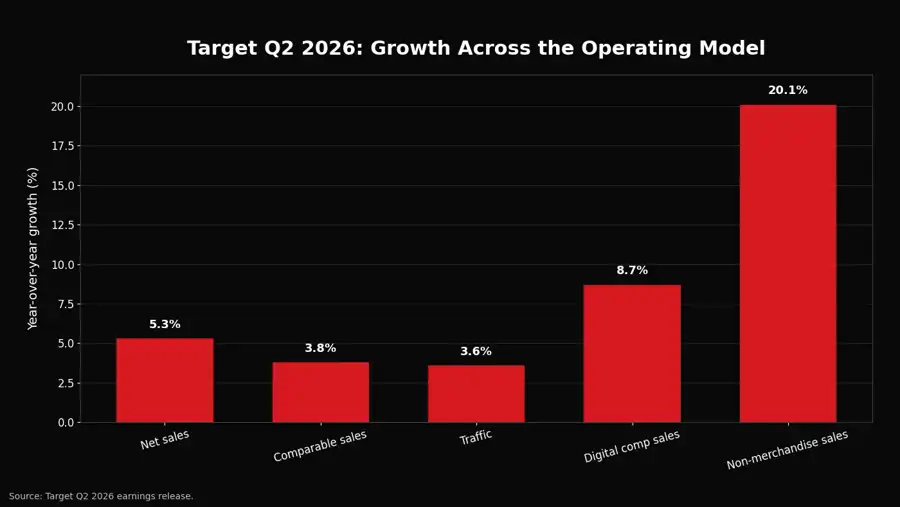
The quarter looked spectacular—until you normalize it
Target reported second-quarter net sales of $26.5 billion, up 5.3% year over year. Comparable sales increased 3.8%, with comparable traffic up 3.6%. Store comparable sales grew 2.7%, while digital comparable sales rose 8.7%. Same-day delivery grew more than 25%, and non-merchandise sales increased 20.1%.
Those are not cosmetic improvements. They point to broader customer engagement and better execution across channels. But the earnings number needs a large footnote. Target reported GAAP and adjusted EPS of $4.11 versus $2.05 a year earlier. The quarter included $994 million of pretax tariff-refund benefits, which contributed about $752 million to net earnings and approximately $1.65 per diluted share.
Without that refund, Target says EPS still increased about 20% year over year. That is a strong result. It is simply not the same result as the headline doubling.
The margin data tells the same story. Reported operating margin reached 9.6%, but the refund added 3.7 percentage points. On a simple normalized basis, that implies roughly 5.9% operating margin versus 5.2% a year ago. That underlying improvement is meaningful because it shows the recovery was not solely an accounting windfall.
This is the analytical rule investors should carry into any earnings season: unusual benefits should be separated from the earnings stream you are willing to capitalize. A one-time refund can improve cash and reported profit, but it should not receive the same valuation multiple as repeatable operating earnings.
The most important number may be traffic, not EPS
Retail turnarounds often produce short-lived margin rebounds before customer behavior genuinely changes. Cost cuts can make a quarter look better. Inventory can be liquidated. Promotions can be shifted. Traffic is harder to fake.
Target’s comparable traffic increased 3.6% in Q2. That matters because traffic tells us customers are choosing Target more often. Comparable sales growth of 3.8% was therefore driven overwhelmingly by visits rather than by a higher average ticket.
There is also a broader top-line signal. On a two-year basis, Target said Q2 net-sales CAGR was 2.1%, a 30-basis-point acceleration from Q1. That is not dramatic, but it is evidence that the improvement is broadening rather than being confined to one quarter or one category.
Operationally, Target completed its largest food transition in more than a decade and, according to management, the largest space move in the company’s history during the quarter. It transformed nearly half of its center-store grocery experience, expanded space for fresh food and faster-growing categories, and simultaneously reported multi-year highs in key reliability metrics and continued improvement in guest satisfaction.
That combination is encouraging. Large merchandising resets usually create disruption before they create benefits. If Target can change substantial parts of the store while improving availability and customer satisfaction, the turnaround becomes more credible.
Digital is becoming a distribution advantage rather than a defensive project
Target spent years being judged against Amazon as if the only relevant question were who could sell more online. That framing is too narrow. The better question is whether Target can use its store network to make digital fulfillment economically attractive.
Digital comparable sales grew 8.7% in Q2, led by more than 25% growth in same-day delivery. Target’s physical stores are not merely retail locations; they are local inventory and fulfillment nodes. A store close to the customer can support walk-in purchases, Drive Up, pickup, same-day delivery and returns from the same asset base.
The advantage is density. If more orders flow through the same local network, labor, routing and inventory utilization can improve. The downside is that same-day fulfillment can become expensive if order density is low or baskets are small. Investors should therefore care less about raw digital growth and more about whether digital growth arrives alongside stronger margins, better availability and higher customer frequency.
So far, the evidence is moving in the right direction. Digital is growing faster than stores without obvious deterioration in the underlying margin picture. Target also opened 17 new stores in Q2, taking year-to-date openings to 24, reinforcing the idea that management still sees the physical network as part of the digital strategy rather than as obsolete retail infrastructure.
Roundel and non-merchandise revenue are improving the quality of growth
The most underappreciated part of Target’s model may be the revenue that does not require Target to sell more physical merchandise.
Advertising revenue was $279 million in Q2, up from $217 million a year earlier—growth of about 29%. Non-merchandise sales overall rose 20.1%, reflecting strength in Roundel advertising, Target Circle 360 membership revenue and the Target+ marketplace. On the earnings call, management also said Roundel gross billings grew nearly 20%, Target+ marketplace GMV increased more than 40%, and Circle 360 membership revenue rose more than 40% year over year.
This is strategically important because these businesses can carry very different economics from traditional retail. A retailer may earn only a few cents of operating profit on each dollar of merchandise revenue. Advertising and membership can monetize customer attention, data, fulfillment access and loyalty without requiring the same inventory investment.
That does not mean Target should be valued like a software company. The core remains retail. But incremental growth from higher-margin service layers can lift consolidated profitability even when merchandise sales grow only modestly.
Walmart is pursuing a similar mix shift. Our recent Walmart analysis shows why advertising, membership and marketplace revenue can make a low-margin retailer structurally more valuable. Target is earlier and smaller in this transition, but the direction is similar.
The merchandising strategy is getting sharper
Target’s historical strength was never lowest price alone. Walmart can usually win that contest. Amazon can win assortment and convenience. Costco can win membership value. Target’s moat has traditionally been the combination of design, discovery, private brands and enough price credibility to make the shopping trip feel rational rather than indulgent.
The Q2 results suggest management is rebuilding that identity with more discipline. All six core merchandising categories grew year over year. Fun 101 posted double-digit growth, while Food & Beverage and Beauty grew at high single-digit rates.
The details are revealing. After the grocery transition, snack sales ran more than 15% above last year. LEGO sales increased more than 30%, plush sales more than 20%, and LoveShackFancy became Target’s largest limited-time collaboration in company history. Those figures do not change the investment case by themselves, but they indicate that Target is again creating reasons to visit beyond simply filling a shopping list.
The company has also lowered prices on more than 10,000 frequently purchased items over the past year and says further value investment will continue. This combination—more newness, more cultural relevance and lower prices on everyday items—is exactly what Target needs. Differentiation without value becomes vulnerable in a pressured consumer environment. Value without differentiation turns Target into a weaker version of Walmart.
AI is interesting—but it is not yet an investment thesis
Management devoted meaningful attention to AI. Target said it has partnered with OpenAI, Google Gemini and other platforms around agentic commerce, and that digital traffic sourced from external AI platforms is growing at more than 3.5 times the industry growth rate compared with a year ago. Importantly, management also described that traffic as still small in total.
Target has appointed a Chief AI Officer and is using AI in personalization, teacher and college wish lists, merchandising and other digital workflows. The wish-list data is more concrete than the external-traffic headline: management said list creation rose more than 50%, items added more than doubled, and conversion across key back-to-school pages improved by nearly 20%.
Those numbers are worth watching, but investors should resist adding an “AI multiple” to the stock. The financial contribution is still small and difficult to isolate.
The real AI opportunity is operational. If Target can use models to improve product discovery, forecasting, personalization, labor allocation and inventory reliability, AI can improve conversion and reduce cost. Those gains would show up indirectly in traffic, gross margin, markdowns and working capital. That is more valuable than a flashy chatbot.
Guidance is better, but the tariff refund complicates the comparison
Target raised its 2026 outlook. Management now expects full-year net sales growth around 5%, one percentage point above its prior range. It expects operating margin around 6%, including roughly 90 basis points of benefit from the Q2 tariff refund. Excluding tariff refunds, management expects the full-year operating margin to be around 50 basis points above last year’s adjusted operating margin of 4.6%.
The company also raised full-year GAAP and adjusted EPS guidance to $9.90 to $10.90. That range includes approximately $1.65 per share from the Q2 tariff refund. At the midpoint, reported guidance is $10.40. Subtract the refund, and the underlying midpoint is roughly $8.75.
That normalized number is still constructive. Management says the midpoint excluding refunds is $0.75 above the midpoint of its prior $7.50-to-$8.50 guidance range. In other words, the business improved even after removing the unusual benefit.
That is the heart of the bull case. The refund made the quarter look spectacular, but the turnaround does not depend on the refund being repeated.
Valuation: the easy money has probably been made
At the August 24 close of $169.89, Target trades at about 16.3 times the midpoint of reported 2026 EPS guidance. That multiple looks undemanding until we remember that the guidance midpoint contains around $1.65 of one-time tariff-refund benefit.
On an underlying midpoint of approximately $8.75, the stock trades closer to 19.4 times normalized 2026 earnings. That is not expensive for a retailer that can sustainably grow earnings at a high-single-digit or low-double-digit rate. But it is also not distressed.
A simple scenario framework helps show what the current price is asking investors to believe:
- Bear case: $8.50 of normalized EPS × 17 = about $145 per share.
- Base case: $8.75 of normalized EPS × 19 = about $166 per share.
- Bull case: $9.00 of normalized EPS × 21 = about $189 per share.
These are not price targets. They are a way to expose the assumptions embedded in the stock. Around $170, the market is already paying for a meaningful portion of the recovery. The stock can still work if traffic remains positive, digital grows faster than stores, Roundel scales and margins improve. But the margin of safety is much smaller than it was when investors were pricing Target as structurally impaired.
Why the stock can still outperform
There are four reasons the rerating could continue.
- Traffic can compound. More customer visits support fixed-cost leverage, advertising inventory and cross-category selling.
- Service revenue can raise the margin ceiling. Roundel, membership and marketplace revenue do not need to become enormous to influence incremental profit.
- Digital fulfillment can improve with density. Same-day delivery growth is valuable if each additional route and order lowers unit cost.
- Merchandising can restore mix. Better performance in home and apparel would broaden the recovery beyond food, beauty and culture-driven categories.
The bear case is no longer collapse—it is disappointment
The downside case has changed. A year ago, the fear was that Target had lost relevance. After Q2, that argument is harder to sustain. The more realistic bear case is that the turnaround works, but not well enough to justify the new valuation.
- Consumer pressure: lower-income households remain sensitive to food, housing and borrowing costs.
- Price investment: reductions on thousands of items can support traffic but pressure gross margin.
- Discretionary weakness: home and apparel are still not where management wants them to be.
- Digital economics: fast delivery can grow revenue faster than profit if fulfillment costs remain elevated.
- Competitive intensity: Walmart, Amazon, Costco, Aldi and category specialists force Target to invest continuously in price and convenience.
- Multiple compression: a stock at a normalized high-teens earnings multiple can fall even if profits grow, especially if interest rates or market risk premiums rise.
What I would monitor from here
For the next two quarters, I would focus on six operating metrics rather than the headline EPS number.
- Comparable traffic: continued positive traffic would confirm customer relevance.
- Digital comparable sales: growth should remain above store growth without eroding margin.
- Same-day delivery: strong growth should eventually show up in better fulfillment economics.
- Roundel and non-merchandise revenue: these are among Target’s highest-quality incremental revenue streams.
- Underlying operating margin: investors should exclude tariff-refund effects and track the clean run rate.
- Home and apparel trends: improvement would show that the turnaround is broadening into categories where Target historically differentiated itself.
The investment conclusion
Target’s Q2 2026 report is more encouraging than the headline earnings number is useful.
The $4.11 EPS figure was inflated by a $1.65 tariff-refund benefit, so investors should not extrapolate it. But removing the refund does not destroy the thesis. It clarifies it.
The core business appears to be recovering. Traffic is positive. Comparable sales are growing. Digital is accelerating. Same-day delivery is gaining adoption. Advertising, marketplace and membership revenue are expanding. Management raised its underlying outlook. Store execution and inventory reliability are improving while Target simultaneously resets large parts of the assortment.
That is real progress.
The problem is that the stock price now recognizes much of it. At roughly 19 times normalized 2026 earnings, Target is no longer priced like a retailer in crisis. New investors are paying for execution.
For existing shareholders, I would view Q2 as confirmation that the turnaround thesis is working and that holding the stock remains defensible. For new buyers, I would be more selective. The business has become easier to like precisely as the stock has become harder to buy cheaply.
Target does not need another one-time windfall to make the investment case work. It needs the next four quarters to prove that traffic, digital density, service revenue and merchandising discipline can convert into sustainable underlying earnings growth. If that happens, today’s valuation can still be justified. If it does not, the recent rerating has already removed much of the cushion.
Sources and data notes
- Target Corporation Q2 2026 earnings release, August 19, 2026
- Target Q2 2026 earnings call and supporting materials
- Target investor relations summary financials
- Market-price reference for the August 24, 2026 close
Valuation scenarios are analytical illustrations, not forecasts or investment advice.
Related U.S. retail research
Target’s recovery is easier to judge against retailers facing the same pressure from tariffs, inventory and value-conscious consumers. Compare the Ross Stores Q2 2026 analysis, where traffic and core margins must be separated from tariff-refund effects, and the American Eagle Outfitters analysis, where Aerie growth, inventory and tariff exposure drive the valuation debate.