Juni 23, 2026
Global Deep Dives

Applied Digital Stock: AI Gold Mine or the Next Data-Center Bubble?

Applied Digital Stock: AI Gold Mine or the Next Data-Center Bubble?
The Kapital · Global Deep Dive · Applied Digital

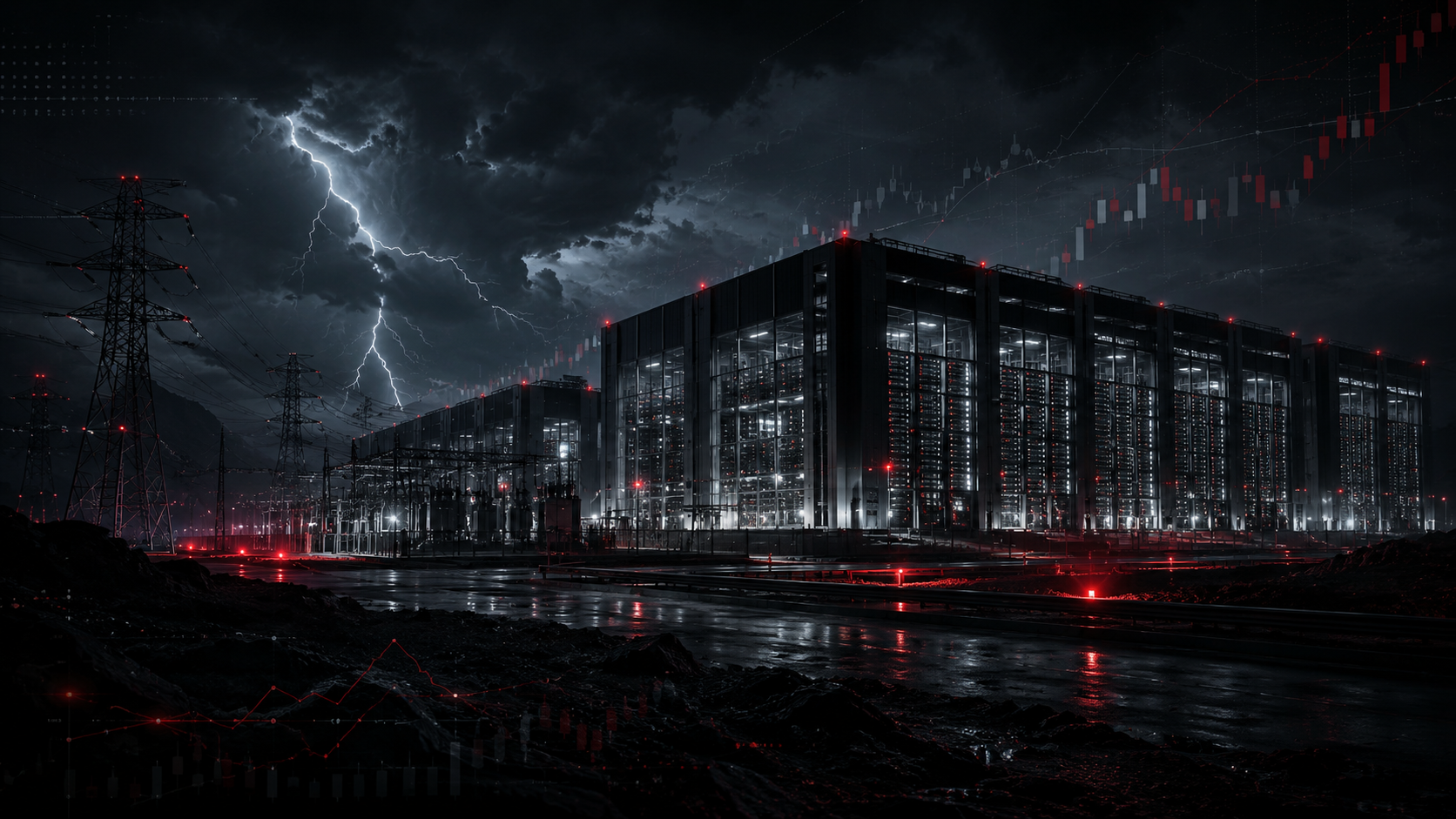
Applied Digital is not selling chips, software or consumer magic. It is selling the physical bottleneck of artificial intelligence: power, land, cooling, data-center shells and execution speed. At roughly $46 per share and a market value above $13 billion, the stock has become one of the most dramatic infrastructure bets in the AI boom — and perhaps one of the easiest places to confuse a lease portfolio with a money-printing machine.

APLD ~$46.20 · market cap ~$13.0B Data cut: June 2026 Reading time: ~15 minutes Not investment advice
This article is independent financial journalism and educational analysis. It is not a recommendation to buy or sell securities.

The thesis: the AI trade has moved from chips to electricity

The first stage of the artificial intelligence boom was easy to understand. Buy the chips. Buy the companies that design the chips. Buy the cloud providers that rent the chips. Then repeat the word “inference” until the valuation multiple politely agrees to leave the room.

The second stage is less glamorous and much more physical. AI does not run on press releases. It runs on power. It needs substations, transformers, water or alternative cooling, high-density racks, zoning approvals, construction labor, grid interconnection, fiber, concrete, creditworthy tenants and a management team capable of turning an investor deck into a live megawatt.

That is where Applied Digital enters the story. The company designs, builds and operates high-performance data centers and colocation facilities for AI, high-performance computing, networking and blockchain workloads. The stock is not a clean value investment. It is not Amazon. It is not a profitable software compounder. It is a leveraged bet that the most important bottleneck in AI is no longer only the GPU, but the ability to host the GPU at scale.

At the current share price area around $46.20, Applied Digital’s market capitalization is roughly $13.0 billion. The trailing P/E is negative because the company remains GAAP-loss-making. This means the stock cannot be judged by a normal earnings multiple. The market is not paying for today’s earnings. It is paying for future contracted capacity, future net operating income, and the possibility that Applied Digital becomes a new kind of AI landlord.

Graphic 1: Applied Digital’s basic tension
$126.6M $36B negative Q3 revenue contracted base revenue GAAP earnings The story is huge. The current income statement is still small.
Sources: Applied Digital Q3 FY2026 results; Reuters report on June 2026 lease portfolio. Figures simplified for visual comparison.

This is why Applied Digital is so interesting. The stock looks absurd if one only reads the income statement. It looks less absurd if one reads the leases. It looks dangerous if one reads the balance sheet. It looks visionary if one believes that AI infrastructure demand will remain constrained for years. It looks insane if one believes the industry is building too much capacity too fast.

“During a gold rush, sell shovels.”Old market proverb, now apparently rewritten as: sell megawatts

The market has already discovered the story. This is not an unnoticed microcap quietly trading below liquidation value. The stock has exploded since the CoreWeave lease announcement in 2025 and has continued to trade like a high-beta proxy for AI infrastructure demand. That alone does not make it overvalued. But it does mean the margin for sloppy analysis is zero.

The current stock setup: momentum, correction risk and a valuation built on tomorrow

Applied Digital recently traded around $46.20, up slightly on the day, with a market capitalization around $13.0 billion. The stock is loss-making on a GAAP basis, with an indicated negative P/E. That is not a small detail. It means the market is effectively capitalizing a future business model, not a mature earnings stream.

The chart is the kind that attracts momentum traders, AI believers, infrastructure bulls and people who use the phrase “once-in-a-generation” too easily. The stock was far lower before the large CoreWeave lease news in 2025. Since then, every major lease, financing and hyperscaler announcement has changed the debate. Applied Digital is no longer a speculative “maybe.” It has real contracts. It also has real construction obligations, real debt and very real execution risk.

Graphic 2: The stock has become an AI infrastructure proxy
pre-lease speculation CoreWeave / hyperscaler lease momentum ~$46 area A real business — but priced for real execution
Illustrative price path, not a tick-by-tick chart. The key point is that the market has already repriced the company around AI infrastructure contracts.

The recent news flow has been extraordinary. In June 2026, Applied Digital signed a new 15-year lease at Delta Forge 2 with a U.S.-based hyperscaler, expected to generate about $5.2 billion in base-term revenue and up to $12.7 billion if renewal options are exercised. The deal covers 210 MW of computing capacity and is expected to begin initial operations in early 2028. After that announcement, Reuters reported that Applied Digital’s contracted base-term lease revenue had increased to around $36 billion, or roughly $86 billion including all renewal options.

A few weeks earlier, in May 2026, Applied Digital announced another major milestone: more than 1 GW of contracted capacity after a 15-year take-or-pay lease for Polaris Forge 3. That agreement added approximately $7.5 billion of base-term contracted revenue and brought the then-total contracted baseline revenue to $31 billion, or $73 billion if all renewal options were exercised.

That is the bull case in one paragraph: a company with a $13 billion equity value has announced tens of billions of future contracted revenue. That sounds cheap. It also sounds like the kind of sentence that should come with a hard hat, a debt schedule and a lawyer.

What Applied Digital actually sells: not AI, but the building around AI

Applied Digital is not Nvidia. It does not control the chip. It is not Microsoft or Amazon Web Services. It does not control the cloud customer relationship at hyperscale depth. It is not a pure data-center REIT either, because the company is still in a development phase, taking construction and financing risk that a stabilized REIT investor would usually prefer to avoid.

The better description is this: Applied Digital is a developer, operator and lessor of AI factory infrastructure. It tries to identify power-rich sites, secure grid-connected utility power, design high-density campuses, finance construction, build capacity and lease that capacity under long-term contracts to AI and hyperscale customers.

Graphic 3: The AI stack — where APLD sits
Applications: AI products, copilots, agents Cloud platforms: hyperscalers, neoclouds, model providers GPUs and accelerators: Nvidia, AMD, custom silicon AI factories: power, cooling, racks, data-center capacity — APLD Grid and physical inputs: land, substations, utilities, labor The unglamorous layer can become the bottleneck. Bottlenecks can become valuable. They can also become overbuilt.

That last sentence is the entire risk. Bottlenecks are valuable until capital discovers them. The AI industry has discovered power, data centers and cooling. Trillions of dollars of announced infrastructure spending have followed. Applied Digital may be early and well-positioned. Or it may be entering a race where the finish line keeps moving and the capital bill keeps growing.

The company argues that its “AI Factory” model is repeatable. It points to North Dakota, the Polaris Forge campuses, waterless cooling, high-density designs, and a growing base of large customers. This is not a vague story anymore. It has contracts, construction schedules and financing. But the business remains a project-execution story first and a financial compounder second.

“The line between disorder and order lies in logistics.”Often attributed to Sun Tzu; for data centers, replace logistics with power delivery

The lease book: enormous, long-dated, and not the same as cash in the bank

The reason the stock has attracted so much attention is simple: the contracted revenue base is now gigantic relative to the current income statement. Applied Digital’s June 2026 Delta Forge 2 lease expanded the contracted base-term revenue figure to about $36 billion, with potential revenue of about $86 billion if all renewal options are exercised. The contracted portfolio spans five campuses, approximately 1.4 GW of critical IT load, and around 2.15 GW of grid-connected utility power.

Before that, the May 2026 Polaris Forge 3 deal had taken contracted base revenue to $31 billion across four AI Factory campuses. This progression matters. The company has moved from “we might lease capacity” to “we have signed long-term take-or-pay arrangements with serious counterparties.” That is an important change in the quality of the story.

Graphic 4: Contracted baseline revenue has exploded
~$7B $31B $36B CoreWeave lease base after Polaris Forge 3 after Delta Forge 2
Figures based on company announcements and Reuters reporting. Contracted revenue is not present-day revenue; it depends on delivery and operation over time.

But this is where investors need to slow down. Contracted revenue is not net income. It is not free cash flow. It is not present value. It is not even risk-free revenue until the facilities are delivered and operating as required. A 15-year take-or-pay lease is valuable, but the lessor still has to build the asset, finance the asset, operate the asset and avoid cost overruns.

The market often commits a charming little error in infrastructure booms: it adds up gross revenue over fifteen years and compares it to today’s market cap as if time, debt, construction costs and operating expenses were minor inconveniences. They are not. They are the business.

What the lease book gives APLDWhat it does not give APLD automatically
Long-term revenue visibilityImmediate free cash flow
Financing credibilityProtection from construction overruns
Validation from large customersUnlimited pricing power
A path to scaleA guarantee of equity returns
Potential annuity streamsA mature REIT-like risk profile today

This is the central distinction: Applied Digital is not yet a finished toll road. It is a company building toll roads very quickly, with customers signing up before every lane is open.

Financials: the current business is still small, messy and rapidly changing

Applied Digital’s fiscal third quarter 2026 showed the transition clearly. Revenue was $126.6 million, up 139% from the prior-year comparable period. Adjusted EBITDA was $44.1 million, compared with $6.3 million in the prior-year period. Adjusted net income was $33.2 million. Those numbers indicate real operational progress.

But the GAAP numbers remain ugly. Net loss attributable to common stockholders was $100.9 million, or $0.36 per share. This is a company scaling through heavy infrastructure investment, non-GAAP adjustments, financing structures and project-level complexity. Anyone who wants clean earnings should probably go buy a soap company and sleep better.

Graphic 5: Q3 FY2026 — growth versus losses
$126.6M $44.1M $33.2M -$100.9M Revenue Adj. EBITDA Adj. net income GAAP net loss
Source: Applied Digital Q3 FY2026 results. Non-GAAP metrics exclude certain items and should not be treated as identical to free cash flow.

The balance sheet is equally revealing. As of February 28, 2026, Applied Digital had $2.1 billion of cash, cash equivalents and restricted cash, against $2.7 billion of debt. It subsequently completed a $2.15 billion private offering of 6.750% senior secured notes due 2031 to fund Polaris Forge 2. In June, it added a revolving credit facility arranged by Goldman Sachs, with up to $350 million of committed capacity and a further $200 million accordion option.

Graphic 6: Balance sheet scale is already serious
$2.1B $2.7B cash + restricted cash debt Infrastructure businesses are financed before they are admired.
Balance sheet figures as of February 28, 2026, from company Q3 FY2026 results.

This balance sheet does not doom the stock. Infrastructure must be financed. Debt can be rational when long-term leases support project cash flows. But debt changes the nature of the equity. If the assets are delivered on time and financed at attractive rates, leverage can amplify returns. If construction slips, costs rise or tenants delay, leverage becomes the shareholder’s least humorous companion.

The bull case: Applied Digital becomes the AI landlord

The bull case starts with a simple observation: AI capacity demand has become physical and urgent. Hyperscalers and AI infrastructure companies need more power-dense facilities than the traditional data-center market can quickly supply. The limiting factor is not only chips. It is where to put them, how to power them, how to cool them and how fast the capacity can go live.

Applied Digital’s advantage is that it has moved quickly to secure large campuses, particularly in power-rich regions, and has already signed long-term leases with major customers. If those campuses become stabilized assets, the company could eventually resemble a high-growth data-center infrastructure platform with long-duration contracted revenue and potential refinancing upside.

1.4 GWcritical IT load across contracted portfolio after June lease
$36Bcontracted base-term revenue after Delta Forge 2
$86Bpotential revenue if renewal options are exercised
70%contracted revenue reportedly backed by U.S. investment-grade hyperscalers
2027–28initial operations expected across newer major campuses
$1B+management’s longer-term NOI ambition within five years

The most important bull-case metric is not current EPS. It is potential net operating income once the campuses stabilize. Management has expressed confidence in exceeding $1 billion of NOI within five years. If that is achieved, the current valuation becomes much more understandable. A data-center platform generating $1 billion of durable NOI could command a very high valuation if the counterparty quality, lease duration and growth pipeline remain strong.

Graphic 7: The bull-case path
LeaseFinanceBuildEnergizeStabilizeRefinance The bull case is not a single event. It is a sequence. The stock works only if the sequence works.

There is also an underappreciated strategic angle: customers may prefer not to own every inch of the physical AI infrastructure themselves. If specialized developers can deliver power-dense capacity quickly, they become valuable partners. Applied Digital is trying to be exactly that partner — not the AI model, not the GPU provider, but the entity that turns theoretical compute demand into a powered facility.

In a world where AI models require more inference, more training, more redundancy and more regional infrastructure, the demand curve may remain far stronger than traditional data-center investors expected. That is the optimistic view. It is not crazy. It is also not guaranteed.

The bear case: a beautiful lease book can still be a brutal equity

The bearish case is not that Applied Digital is fake. That would be too easy and probably wrong. The company has real contracts, real campuses, real financing and real customers. The bearish case is subtler: the assets may be real, the revenue may be contracted, and shareholders may still be taking more risk than the market admits.

1. Execution risk

Applied Digital must deliver large, complex facilities on aggressive schedules. Construction delays, supply-chain issues, labor constraints, utility interconnection problems or cooling-system issues could push revenue recognition later and increase costs. A one-quarter delay in a software launch is annoying. A multi-month delay on a multi-hundred-megawatt AI factory can be financially painful.

2. Financing risk

The model depends on access to capital. Senior secured notes, revolving credit facilities, project-level financing and possible future refinancing are part of the story. If credit markets tighten, rates rise or investors begin to question AI infrastructure returns, the cost of capital could become a serious headwind.

3. Customer concentration

CoreWeave has been a critical customer, and hyperscaler relationships dominate the investment story. Credit enhancements and investment-grade structures help, but concentration still matters. When a small company depends on a handful of enormous tenants, the tenant may be creditworthy but the supplier is still exposed to relationship and execution dynamics.

4. AI overbuild risk

This is the most dangerous risk because it is the hardest to see in real time. Every boom believes it is constrained until the capacity arrives. If the AI infrastructure industry overbuilds, lease economics could weaken, new projects could become harder to finance, and the market could re-rate development-stage data-center equities sharply lower.

5. Dilution and equity risk

Even if the business succeeds, shareholders must pay attention to capital structure. Infrastructure growth may require debt, equity, joint ventures or asset-level financing. The right financing can create value. The wrong financing can transfer value away from common shareholders.

Graphic 8: Risk map — what can break the story?
APLD equity story Construction delays / costs Financing rates / access Customers concentration Overbuild AI capacity cycle
“In the short run, the market is a voting machine, but in the long run it is a weighing machine.”Benjamin Graham

Applied Digital is currently benefiting from the voting machine. Investors are voting for AI capacity, power scarcity and long-term leases. Eventually, the weighing machine will ask a less exciting question: how much cash did the assets actually produce for common equity holders?

Valuation method one: revenue-backlog framing

The most tempting valuation shortcut is to compare the $36 billion contracted base-term revenue figure with the roughly $13 billion market capitalization. On the surface, the stock looks cheap: the contracted revenue base is almost three times the equity value. Add renewal options and the comparison becomes even more dramatic.

But this is not a software backlog. It is a long-dated infrastructure lease portfolio. Revenue arrives over many years. It requires enormous upfront capital. It carries operating costs, interest costs, maintenance requirements and execution risk. Still, the backlog framework can be useful if treated properly.

MetricApproximate valueInterpretation
Market capitalization~$13.0BCurrent equity value
Base-term contracted revenue~$36BLong-term gross revenue visibility
Potential revenue with renewals~$86BNot guaranteed; option-dependent
Market cap / base contracted revenue~0.36xLooks low, but gross revenue is not cash flow
Market cap / renewal potential~0.15xInteresting headline, dangerous if taken literally
Graphic 9: Market cap versus contracted revenue
$13B $36B $86B market cap base contracted with renewal options
The visual shows why the story is exciting. It does not show profitability, timing, capex or financing costs.

On this basis alone, the stock can be defended. The problem is that revenue-backlog valuation is only the first page of the book. Investors who stop there are not valuing the company. They are admiring the headline.

Valuation method two: NOI scenarios

For Applied Digital, the more useful framework is stabilized net operating income. Management has pointed to the potential to exceed $1 billion of NOI within five years. If achieved, the stock can work from current levels. If missed badly, the current valuation is far less forgiving.

Below is a simple scenario model. It is not a target price. It is a stress test of what the market might be assuming.

ScenarioStabilized NOIMultipleEnterprise valueEquity value after adjustmentsValue / share
Bear$650M14x$9.1B~$7.0B~$21
Base$1.05B18x$18.9B~$16.3B~$49
Bull$1.45B22x$31.9B~$28.6B~$86
Graphic 10: NOI valuation scenarios
current price area: ~$46 $21 $49 $86 Bear Base Bull
Scenario model uses simplified assumptions, approximate share count and conservative adjustments for debt/project financing. It is illustrative, not a formal price target.

This model explains the current stock price better than conventional valuation. Around the mid-$40s, the market is already pricing something close to a successful base case. The stock is not obviously cheap unless the investor believes the NOI path is above $1 billion and the market will apply a premium multiple to the platform.

The bear case is severe because development-stage infrastructure equities can derate quickly when investors lose confidence in the buildout. The bull case is powerful because long-duration AI infrastructure cash flows backed by strong tenants could attract premium valuation. This is exactly why the stock is so volatile. The fair value is not a point. It is a canyon.

Valuation method three: discounted lease economics

Another way to frame Applied Digital is to think like a landlord financing long-term leases. Suppose the company turns part of its $36 billion contracted base-term revenue into recurring annual revenue over roughly 15 years. That implies an average gross revenue stream around $2.4 billion per year once delivered, though timing will ramp and not all projects start immediately.

The question then becomes: what percentage of that gross revenue eventually turns into distributable cash flow after operating costs, maintenance, interest and corporate costs? For a stabilized, high-quality data-center platform, attractive margins are possible. For a fast-scaling developer with heavy financing needs, the path is not clean.

Cash conversion assumptionImplied cash generation on $2.4B annual revenueInterpretation
20%~$480MToo low for current market cap unless growth continues strongly
35%~$840MSupports part of current valuation, but not obvious upside
45%~$1.08BBegins to justify current price and possible upside
55%~$1.32BBullish infrastructure-quality outcome
Graphic 11: Cash conversion sensitivity
$480M $840M $1.08B $1.32B 20% 35% 45% 55%
Illustrative annual cash generation from a simplified $2.4B revenue base. Actual timing, margins and financing costs may differ materially.

The conclusion is similar: Applied Digital is not cheap because the current income statement says so. It is potentially attractive if the contracted portfolio converts into high-quality, high-margin, long-duration cash flows. That is a large “if,” and the stock price already assumes a meaningful portion of it.

The unconventional angle: Applied Digital is really a power arbitrage company

Most articles will call Applied Digital a data-center stock. That is true, but incomplete. The more interesting angle is that Applied Digital is trying to monetize power-location arbitrage.

AI customers do not merely need data centers. They need data centers where sufficient power can be accessed, connected and delivered at the right density. The value is not only the building. The value is the combination of utility power, land, climate, cooling design, interconnection timelines, political acceptance and construction execution. In the AI era, a megawatt in the right place at the right time can be worth far more than a megawatt trapped behind a five-year interconnection queue.

This is why places like North Dakota matter. They are not obvious AI glamour locations. That is the point. If you are building the physical internet of AI, you do not necessarily need a glass tower in Palo Alto. You need electrons, land and speed. The glamour comes later, if the cash flows arrive.

The rare angle: Applied Digital may not be a “data-center company” in the usual sense. It may be a way to own scarce grid-connected AI power capacity before that scarcity is fully priced into long-duration infrastructure assets.

That is also why the company’s proprietary waterless cooling and high-density architecture deserve attention. Cooling is not a marketing footnote. At AI rack densities, thermal management becomes part of the economic model. If Applied Digital can deliver high-density facilities with lower water dependency and reliable operations, the platform may deserve a premium. If the technology disappoints, it becomes another execution risk.

What would make me more bullish?

The stock is fascinating, but fascination is not a margin of safety. Here are the signals that would make the thesis stronger over the next 12 to 24 months.

SignalWhy it matters
Facilities delivered on or ahead of scheduleConfirms the company can execute the AI Factory model repeatedly
Stable or improving project-level marginsShows that gross revenue can convert into attractive NOI
Lower financing costs after stabilizationValidates management’s refinancing thesis
More investment-grade hyperscaler tenantsReduces customer concentration and improves portfolio quality
Limited dilutionProtects common shareholders from losing the upside
Clear disclosure by campusAllows investors to value the platform with less guesswork

The last point matters more than most people think. Applied Digital’s story is complicated. Better project-level disclosure would reduce the discount investors should apply. In infrastructure, opacity raises the cost of equity. If management wants a premium multiple, it must eventually give the market enough detail to underwrite that premium.

What would break the thesis?

The thesis breaks if one of three things happens: the AI capacity cycle slows materially, the company fails to deliver campuses on schedule and on budget, or the financing stack becomes too expensive for common shareholders to earn attractive returns.

The scary part is that these risks are connected. If AI demand slows, financing becomes harder. If financing becomes harder, construction becomes riskier. If construction slips, customer confidence can weaken. If customer confidence weakens, the market may stop capitalizing future lease revenue at attractive multiples. Infrastructure booms often turn not because one variable breaks, but because several variables stop supporting each other at the same time.

That does not mean Applied Digital should be avoided. It means the position sizing should reflect reality. This is not a defensive stock. It is not a “hide here if the market falls” stock. It is a high-upside, high-volatility, high-execution-risk equity linked to one of the largest capital cycles in modern technology.

“Risk comes from not knowing what you’re doing.”Warren Buffett

With APLD, the risk is not only not knowing the company. The risk is not knowing which layer of the AI cycle you are actually underwriting. You are not buying AI demand in the abstract. You are buying a development-stage infrastructure platform whose equity value depends on turning demand into completed, financed, operating assets.

Final judgment: not a bubble by default, not a bargain by default

Applied Digital is one of the more interesting public equities in the AI infrastructure chain because it sits where the digital dream becomes a physical constraint. The company is trying to own and operate the scarce layer beneath the AI boom: power-dense data-center capacity. That is a better business idea than many investors realize.

But the stock has already been discovered. At roughly $46 and a market value above $13 billion, the easy money is no longer in merely recognizing the story. The market already recognizes the story. The question now is whether the story can become cash flow fast enough, cleanly enough and cheaply enough to justify the valuation.

My base-case view is that Applied Digital is roughly fair to slightly attractive only if one believes management can reach something close to the $1 billion-plus NOI ambition and maintain access to favorable financing. Under that scenario, a value around the high-$40s to low-$50s can be defended. The bull case can go much higher if the company proves the AI Factory model is repeatable and becomes a premium infrastructure platform. The bear case is severe if construction, financing or AI capacity demand disappoints.

This is not Amazon, where the business is already a fortress and the debate is about how to value the next layer. Applied Digital is a construction site with contracts. A very valuable construction site, perhaps. But still a construction site.

The best way to phrase the investment case is simple:

APLD is not a bet that AI is real. That is too broad. APLD is a bet that AI infrastructure remains power-constrained, that large customers continue leasing capacity, and that Applied Digital can finance, build, energize and operate that capacity without giving away too much of the upside.

If that happens, today’s valuation may look conservative in hindsight. If it does not, the stock can fall a long way while still leaving the company operationally alive. That is the nature of leveraged infrastructure equity. The business can be real. The stock can still be dangerous.

Applied Digital may be building a gold mine. It may also be building exactly what every boom eventually builds too much of. The difference will not be decided by slogans about AI. It will be decided by megawatts delivered, capital costs paid, tenants retained, and cash flow earned.

That is why APLD is worth studying. Not because it is obvious. Because it is not.

Sources and notes

  • Applied Digital Q3 FY2026 results: revenue, net loss, adjusted EBITDA, cash, restricted cash and debt figures.
  • Applied Digital May 2026 Polaris Forge 3 lease announcement: $31B base contracted revenue, $73B including renewal options, 1.2 GW critical IT load.
  • Reuters June 2026 report on Delta Forge 2: $5.2B 15-year lease, 210 MW, $36B base contracted revenue and $86B including renewal options.
  • Applied Digital June 2026 revolving credit facility announcement: up to $350M committed capacity plus $200M accordion option.
  • Applied Digital 2025 CoreWeave lease announcement: 250 MW, approximately $7B expected revenue over around 15 years.
  • Market data around June 18, 2026: APLD around $46.20, market capitalization roughly $13.0B and negative trailing P/E.

Valuation models are simplified and use assumptions. They are intended to frame the debate, not to provide a precise target price. This article is not investment advice.

Schreibe einen Kommentar

Deine E-Mail-Adresse wird nicht veröffentlicht. Erforderliche Felder sind mit * markiert