
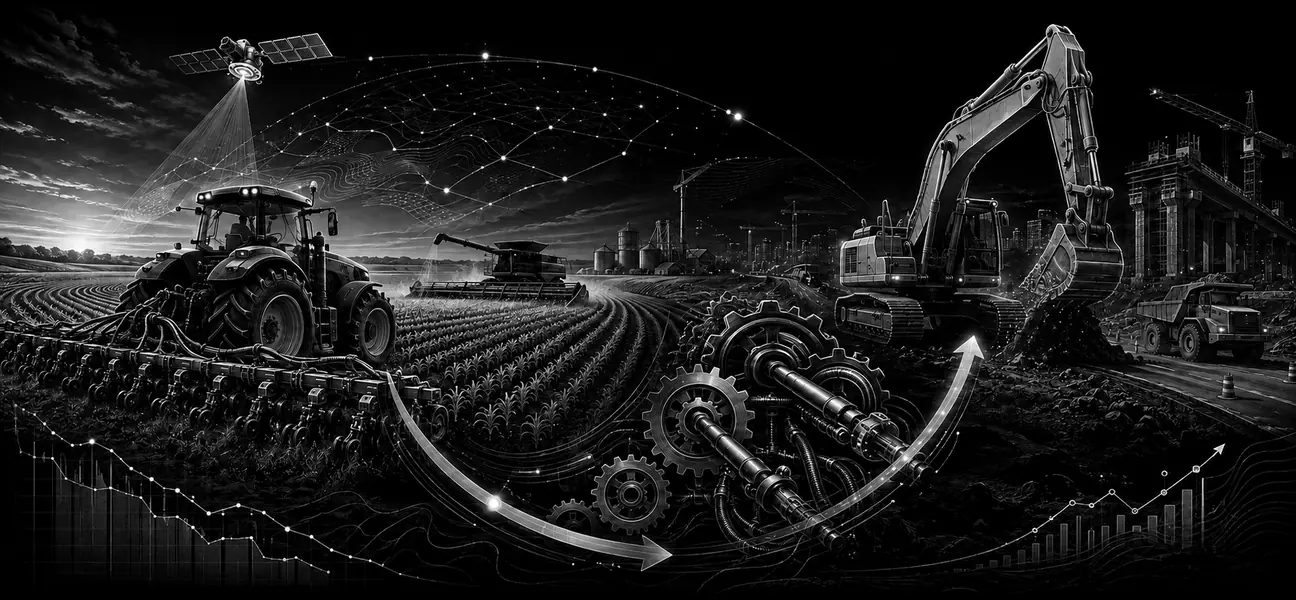
Data as of August 22, 2026. Deere stock jumped after the company’s fiscal third-quarter report even though management said 2026 is likely to mark the bottom of the agricultural cycle. That apparent contradiction is the whole investment case. Markets do not wait for earnings to recover; they try to price the recovery before it appears. Deere’s construction business is already strong, its precision-agriculture franchise remains strategically valuable, and management maintained full-year net income guidance of $4.75 billion to $5.0 billion. At roughly $647 per share, however, investors are paying well ahead of the trough.
I think Deere is one of the highest-quality cyclical companies in the market. That does not make it a low-risk stock at any price. The third quarter demonstrated both sides: Production and Precision Agriculture sales fell 6%, while Construction and Forestry sales grew 18% and operating profit surged. The company is diversified enough to absorb a farm downturn, but the current valuation assumes that today’s weak agricultural earnings are temporary and tomorrow’s recovery will be powerful.
Deere stock after Q3 2026: the essential numbers
Deere reported quarterly net sales and revenues of $12.61 billion and net income of $1.379 billion, equal to $5.10 per diluted share. The result was better than a simple reading of the farm cycle would suggest. Construction and Forestry became the counterweight, while Small Agriculture and Turf sales also grew 12%. Management kept its fiscal-year net income outlook at $4.75 billion to $5.0 billion.
- Total net sales and revenues: $12.61 billion.
- Net income: $1.379 billion.
- Diluted EPS: $5.10.
- Production and Precision Agriculture sales: down 6%.
- Construction and Forestry sales: up 18%.
- Fiscal 2026 net-income outlook: $4.75 billion to $5.0 billion.
The mix matters more than the consolidated growth rate. Agricultural equipment has historically produced Deere’s largest cyclical swings. Farmers replace large tractors and combines when crop economics, fleet age, interest rates and confidence line up. Construction customers respond to infrastructure spending, nonresidential activity and equipment utilization. One business is near a trough; the other is carrying the income statement.
This is not diversification in the defensive-consumer sense. Both segments are capital-intensive and economically sensitive. But their cycles do not move perfectly together. In Q3 that difference prevented an agricultural slowdown from becoming a group-wide earnings collapse.
Why the agricultural trough matters
When management calls 2026 the bottom of the agricultural cycle, investors should hear a probabilistic statement, not a guarantee. A bottom requires dealer inventories to normalize, used-equipment values to stabilize and farmer cash flows to stop deteriorating. Crop prices, input costs and financing conditions remain outside Deere’s control.
Yet the company has already taken actions that distinguish this downturn from older cycles. Production discipline has improved. Deere can use connected machines, dealer data and order visibility to adjust output earlier. It can also monetize software, services and precision tools across the installed base rather than relying solely on new-unit volume. Those advantages do not abolish cyclicality; they can reduce the amount of capital trapped when demand turns.
The bear case is that the market has declared the trough before customers have. If weak farm economics persist into 2027, equipment replacement can be delayed again. In that case, current earnings may be a plateau rather than the floor. The bull case is that dealer inventory and production cuts have done their job, leaving Deere with strong incremental margins when orders recover.
Precision agriculture is Deere’s quality premium
Deere is no longer just selling horsepower and steel. Its most important strategic asset is a system that connects machines, field data, guidance, autonomy and agronomic decisions. A farmer does not buy technology for novelty. The value proposition must show up in fewer passes across a field, lower fuel use, more precise application of seed and chemicals, less labor or higher yield.
That creates two potential economic benefits. First, software and digitally enabled features can increase revenue per machine. Second, a connected installed base can raise switching costs because equipment, data history, dealer service and workflow become intertwined. The risk is that investors capitalize those benefits as if Deere were a recurring-revenue software company. It is not. The hardware remains expensive, purchases remain cyclical and farmers remain disciplined buyers.
I view precision agriculture as a reason Deere deserves a premium to a traditional machinery manufacturer, not as a reason the cycle no longer matters. The distinction is important at 36 times trailing earnings.
Construction is doing the heavy lifting
Construction and Forestry sales increased 18% in the quarter, while segment operating profit rose much faster. That is operating leverage in its most attractive form: stronger volume, improved mix and a relatively fixed industrial base convert incremental sales into disproportionate profit.
The segment benefits from infrastructure activity and from the acquired Wirtgen roadbuilding portfolio. It also gives Deere exposure to a customer base whose economics differ from row-crop farming. But investors should not extrapolate an 18% growth rate indefinitely. Construction equipment is cyclical, and unusually strong margins often attract competition or normalize as mix changes.
There is an instructive connection to the industrial build-out behind Homerun Resources’ solar-glass strategy: ambitious physical projects create real equipment demand, but financing conditions determine how quickly plans become orders. Deere’s construction strength is valuable precisely because project backlogs are currently converting. If capital costs rise further, that conversion can slow.
The financial-services engine adds leverage
Deere helps customers finance equipment, which supports sales and deepens the relationship. It also means the company carries credit and funding exposure. In good cycles, financial services can make the industrial franchise more efficient. In weak cycles, delinquencies, residual values and funding costs deserve attention.
Higher interest rates affect Deere twice. They make a new machine more expensive for the customer and they increase the required return investors place on Deere’s future earnings. The mechanics are similar to the valuation pressure described in my guide to why rising bond yields compress equity multiples. Deere is cyclical rather than a long-duration software stock, but a premium multiple still needs a low enough discount rate and credible earnings growth.
The practical indicators are allowance levels, past-due receivables, financing spreads and used-equipment prices. A deterioration in all four would signal that an industrial slowdown is migrating into the balance sheet.
Deere valuation: the stock is pricing a recovery
At $647.47 on August 21, Deere traded at about 36.7 times trailing earnings. That multiple is optically high because trough earnings are the wrong denominator for a cyclical company. The better question is what Deere can earn on a normalized basis and what multiple those earnings deserve.
Using the midpoint of management’s $4.75 billion to $5.0 billion net-income outlook and a share count near recent levels implies current-year earnings in the high teens per share. A recovery toward the mid-to-high $20s would reduce the effective multiple substantially. But investors should not use the prior peak mechanically: exceptional agricultural profits can make peak EPS look normal just before it falls.
| Scenario | Normalized EPS | Multiple | Indicative value |
|---|---|---|---|
| Bear | $24 | 22 | $528 |
| Base | $28 | 23 | $644 |
| Bull | $32 | 24 | $768 |
The base case lands close to the market price. It assumes agricultural demand recovers, construction remains healthy and precision tools support a higher-quality revenue mix. The bear case still grants Deere a premium multiple but assumes a slower farm recovery. The bull case requires earnings to approach prior-cycle strength without a material contraction in the valuation multiple.
That is a demanding setup. The stock can work if earnings rise into the price, but the margin of safety is limited if the trough lasts longer than management expects.
What I would watch next
Large-tractor and combine orders
Dealer commentary and order books should show stabilization before production turns. Rising retail demand without inventory rebuilding would be the cleanest signal.
Used-equipment prices
Residual values influence trade-ins, customer equity and finance losses. Stable used prices make new equipment easier to sell and protect Deere Financial.
Construction margins
Current growth is strong. The question is whether margin expansion persists once easy comparisons and favorable mix fade.
Production discipline
A premature production increase would recreate dealer inventory risk. Controlled output is more valuable than chasing one quarter of revenue.
Precision-agriculture adoption
Investors need evidence that customers pay for measurable productivity, not just that Deere can demonstrate impressive technology.
Risks to the investment thesis
What would change my view
I would become more constructive if large-ag order rates stabilize for two quarters, dealer inventories fall without heavy incentives and used-equipment values hold. I would become more cautious if construction margins peak before agriculture recovers or Deere Financial shows simultaneous pressure in delinquencies and residual values. These indicators matter more than one earnings beat because they reveal whether the cycle is actually turning.
Capital allocation through the cycle
A cyclical company creates the most shareholder value when it invests before demand returns without overproducing into weakness. Deere must fund research, factories and dealer support while protecting the balance sheet of its finance operation. Buybacks can be attractive near a trough, but only if management is not using peak-cycle assumptions to judge intrinsic value.
I would rather see Deere preserve production discipline and finance its autonomy roadmap than maximize one year of repurchases. The company’s installed base gives it opportunities to sell upgrades and services with less capital than a new machine requires. If that revenue becomes more visible, the quality of normalized earnings improves. If it remains bundled into hardware, investors should continue to value Deere primarily as an industrial cyclical.
The best capital-allocation outcome is therefore not the highest near-term EPS. It is a cleaner dealer channel, protected credit quality and capacity ready for genuine retail demand. That setup would allow the next recovery to generate cash rather than merely liquidate excess inventory.
- A longer farm recession: weak crop economics could delay replacements beyond 2026.
- Construction normalization: today’s strongest segment could become less supportive.
- Credit deterioration: lower used values and higher delinquencies would pressure financial services.
- Execution risk: autonomy and software must deliver a clear customer return.
- Valuation risk: even better earnings may not lift the stock if the multiple contracts.
Catalysts
The most important positive catalyst would be evidence that large-agriculture retail sales have stopped falling. Additional catalysts include lower dealer inventories, stable used-equipment auctions, better farm income, continued infrastructure demand and a higher share of paid precision features. A decline in financing costs would help both equipment affordability and the valuation multiple.
My conclusion on Deere stock
Deere delivered a strong quarter relative to a difficult agricultural environment. Construction and Forestry proved that the portfolio can carry a weak farm segment, while the full-year outlook suggests management has the downturn under control. I also believe precision agriculture makes Deere a structurally better business than it was in earlier cycles.
But a better business can still be a fully valued stock. At about $647, the market is already looking across the trough. My base scenario is close to the current price, which means the upside depends on a faster or more profitable recovery than I consider necessary for a balanced forecast. I would prefer either a lower entry price or clearer proof that agricultural orders are turning.
For existing long-term holders, the quarter supports patience. For new buyers, it argues for discipline. Deere is not priced like a company at the bottom; it is priced like a company that has already begun climbing out.
FAQ
Why did Deere stock rise if agriculture is weak?
Markets discount future results. Strong construction earnings, maintained guidance and the possibility that 2026 marks the farm-cycle bottom encouraged investors to look beyond current agricultural weakness.
Is Deere a technology company?
Deere has valuable software, autonomy and data capabilities, but its economics still depend heavily on cyclical hardware. Technology improves the franchise; it does not eliminate the machinery cycle.
What is the biggest risk for Deere stock?
The biggest risk is a longer agricultural downturn combined with a lower valuation multiple. At the current price, the stock has limited room for both earnings and sentiment to disappoint.
Primary sources
- Deere & Company: fiscal Q3 2026 earnings
- SEC: Deere Q3 earnings exhibit
- Deere investor relations: quarterly earnings
This article is analysis, not investment advice. Valuation scenarios are illustrative and are not price targets or guarantees.
Related industrial-cycle research on The Kapital
Deere’s farm-cycle trough is easier to judge when it is compared with another high-quality machinery business facing a different mix of end markets. Our Caterpillar analysis looks at construction, mining, power generation and data-center infrastructure and asks the same core question: has a cyclical company’s earnings floor moved structurally higher?