

The Kapital · Global Deep Dive · 20 August 2026
Micron used to be one of the cleanest examples of a brutal semiconductor cycle: demand would surge, factories would expand, supply would catch up, prices would collapse, and investors would rediscover that memory was still a commodity. In 2026 that description is no longer sufficient. AI has turned high-bandwidth memory into a strategic bottleneck, Micron is signing multi-year agreements with pricing floors, and quarterly gross margins have moved into territory that would have looked absurd only a few years ago. The question is whether this is a permanently better business—or simply the most profitable point of the memory cycle ever recorded.
Micron has become one of the strangest valuation exercises in the market. A company that generated $9.3 billion of quarterly revenue one year ago just reported $41.5 billion. Gross margin went from 39% to almost 85% on a non-GAAP basis. Management now guides to roughly $50 billion of revenue next quarter and about 86% gross margin.
If I annualize those numbers mechanically, Micron can look ridiculously cheap even after a historic share-price rally. But that is exactly where memory investors usually get hurt. Peak earnings are not normal earnings. A low multiple on a cyclical peak can be more dangerous than a high multiple on a stable business.
The quarter that broke the old Micron model
Fiscal third-quarter 2026 revenue reached $41.46 billion, up from $23.86 billion in the previous quarter and $9.30 billion a year earlier. Non-GAAP gross margin reached 84.9%, operating income was $33.68 billion and adjusted free cash flow came in at $18.3 billion.
Those numbers are not normal semiconductor numbers. They look closer to the economics of a software platform than a historically commoditized memory manufacturer. The reason is not accounting magic. It is an extreme imbalance between demand for advanced memory and the supply that can actually be qualified for AI systems.
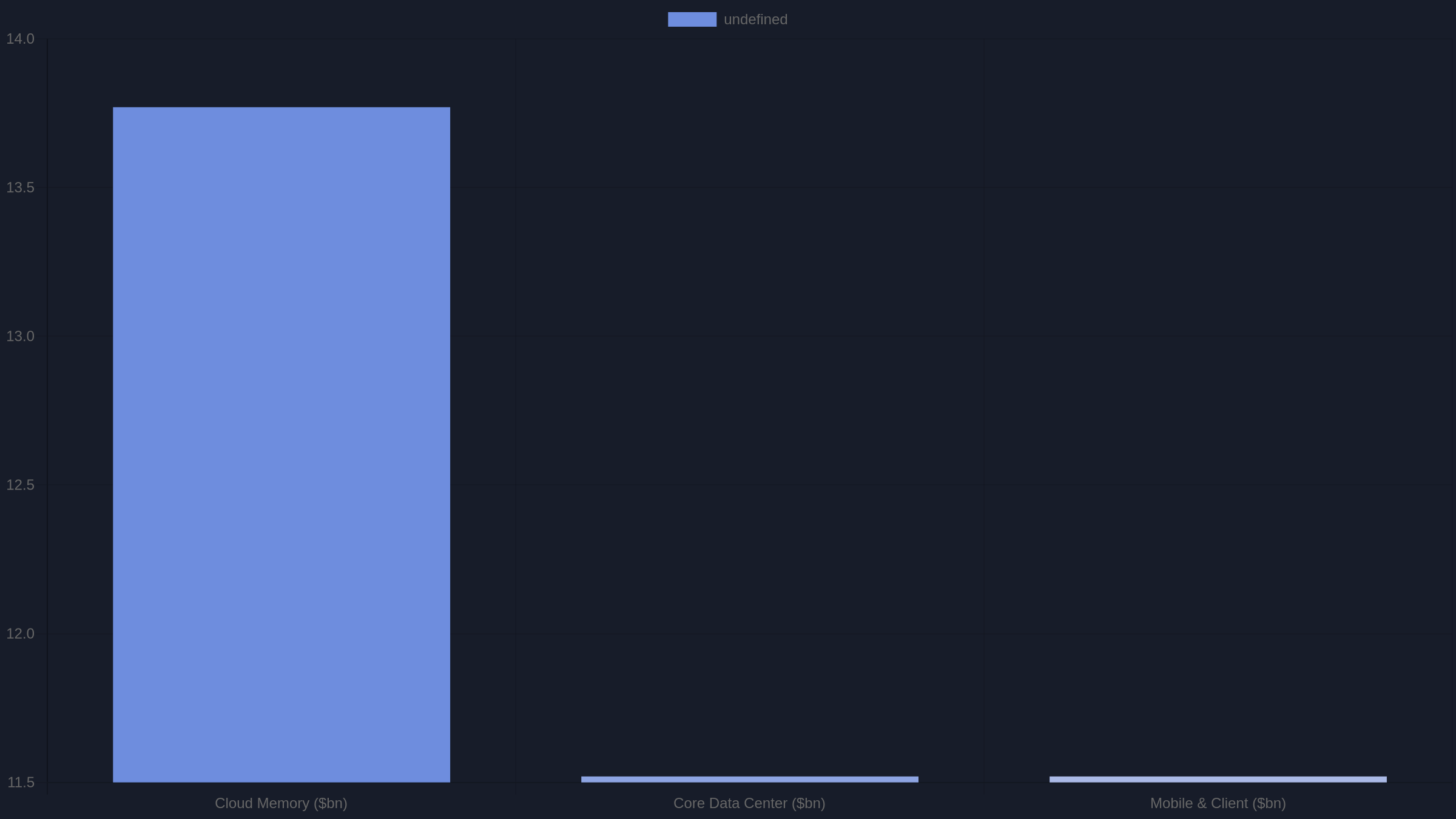
The most important detail is that strength is no longer isolated to one line item. Cloud Memory produced $13.77 billion of revenue, Core Data Center $11.52 billion, Mobile and Client $11.52 billion and Automotive and Embedded $4.63 billion. AI is the catalyst, but the shortage is spreading pricing power across the memory stack.
HBM changed memory from interchangeable to strategic
The old memory business was built around fungibility. A PC manufacturer or smartphone producer could often shift orders between suppliers when pricing moved against them. That made capacity discipline difficult and bargaining power fragile.
HBM is different. High-bandwidth memory sits next to the accelerator and has to be engineered, qualified and integrated around a particular compute platform. Micron’s roadmap is aligned with Nvidia’s AI systems, and HBM4 is already in high-volume shipments for its lead customer platform. HBM4E is in development for volume production expected in calendar 2027.
That customization matters. The closer memory becomes to a co-designed component rather than a generic part, the harder it is for a customer to switch suppliers overnight. That is one reason I think Micron deserves a structurally higher quality multiple than it did in previous cycles.
The company is also pushing into products around the same bottleneck: high-capacity DDR5 server modules, SOCAMM memory, advanced SSDs and automotive memory. The central theme is the same everywhere: more compute creates more data movement, and more data movement requires more memory bandwidth.
The $22 billion of customer commitments may be more important than the quarter
Micron announced $22 billion of strategic customer commitments across 16 customers. Reuters reported that the agreements include take-or-pay provisions, cash deposits and pricing floors. Management also disclosed roughly $100 billion of remaining performance obligations tied to customer agreements signed so far.
This is a very different commercial model from the one investors associate with memory. Historically, the industry produced first and negotiated pricing later. Today, customers are effectively helping secure future supply before capacity arrives.
That does not eliminate cyclicality, but it can reduce its violence. A five-year commitment with a pricing floor does not guarantee the same margin every quarter, yet it gives Micron more visibility before it spends billions on fabrication capacity.
The margin expansion is extraordinary—and dangerous to extrapolate
Micron’s non-GAAP gross margin was 39.0% in fiscal Q3 2025. It rose to 74.9% in fiscal Q2 2026 and 84.9% in fiscal Q3. The fourth-quarter guide is approximately 86%.
That is the statistic I find most impressive and most dangerous.
Margins this high tell me two things. First, the shortage is real. Customers are paying for availability, not just manufacturing cost plus a normal markup. Second, a lot of the current valuation depends on scarcity lasting long enough for today’s earnings power to become a meaningful part of cumulative shareholder value.
Management says tight conditions could persist beyond calendar 2027 because AI demand is growing while supply expansion remains structurally constrained. That is credible. Building and qualifying memory capacity takes years, and HBM consumes significantly more wafer capacity than conventional DRAM for the same amount of bit output.
But I still refuse to treat an 86% gross margin as normal. If supply catches up, pricing will soften before demand disappears. Memory cycles usually turn at the margin, not when factories suddenly become empty.
The balance sheet has changed with the cycle
At the end of fiscal Q3, Micron held roughly $30.2 billion of cash, marketable investments and restricted cash. Long-term debt had fallen to about $5.1 billion from roughly $14.0 billion at the end of fiscal 2025. Shareholders’ equity reached $100.7 billion.
This is what I want a cyclical company to do during a boom: strengthen the balance sheet before the market turns.
The company is simultaneously spending aggressively. Fiscal Q3 capital expenditure was $7.1 billion and management expects around $10 billion in fiscal Q4. In July, Micron increased its U.S. investment plan to more than $250 billion through 2035, including its New York, Idaho and Virginia manufacturing footprint.
That expansion is necessary if AI demand keeps compounding, but it is also the source of the eventual bear case. The industry always needs new capacity at precisely the moment when current capacity earns the highest returns. The key question is whether long-term contracts and HBM qualification barriers are strong enough to stop new supply from destroying economics later.
China is the long-term competitive risk investors should not ignore
Micron’s near-term competitive position is excellent, but the global memory map is changing. Chinese DRAM producer CXMT has become a meaningful player, while YMTC continues to expand in NAND. Reuters reported that Chinese producers are already using strong domestic demand to push pricing higher and are planning major capacity additions.
For now, export controls and technology restrictions limit how quickly those companies can close the gap at the leading edge. Micron also benefits from being the only major U.S.-based HBM manufacturer, which gives it strategic value well beyond a normal semiconductor company.
But investors should not confuse geopolitical protection with permanent economic protection. If Chinese suppliers expand aggressively in conventional DRAM and NAND, they can pressure the lower end of the market even if HBM remains protected. That could force Micron to lean even harder into premium products.
Why the stock can fall 7% while the business remains excellent
On August 18, Micron fell about 7% during a broader semiconductor selloff as Treasury yields climbed. That move says something important about the stock today. The company is no longer trading like a sleepy cyclical manufacturer. It is trading like a high-beta AI asset.
This links Micron directly to the same duration problem affecting Nvidia, Amazon and other AI winners. When long-term yields rise, investors demand a higher discount rate for future cash flows. High-expectation stocks get repriced first, even when near-term fundamentals remain strong.
I discussed the financing side of the AI boom in my Nvidia analysis, and the capex side in my Amazon analysis. Micron sits underneath both themes: it sells the memory needed to turn AI capital spending into physical compute capacity.
Valuation: I refuse to use peak EPS as normal earnings
Micron traded around the mid-$900s after the August 18 pullback, after having closed above $1,000 a day earlier. At those levels, the company can appear cheap against current quarterly earnings. Fiscal Q4 guidance of roughly $31 in adjusted EPS annualizes to more than $120 a share.
I do not think investors should multiply that number by a normal semiconductor P/E and call it fair value. That would assume the shortage persists almost indefinitely.
Instead, I use a three-scenario framework built around how much of the current earnings power survives normalization.
Bear case: $700
In the bear case, memory supply catches up faster than expected during 2027. HBM remains attractive, but conventional DRAM and NAND pricing softens, gross margins fall sharply from current extremes and investors once again value Micron as a premium cyclical business rather than an AI scarcity asset.
Base case: $1,100
My base case assumes HBM remains structurally constrained, multi-year contracts reduce the depth of the next downturn and Micron keeps a materially better margin profile than in pre-AI cycles. Earnings normalize below today’s run rate but stay far above the levels investors historically associated with the company.
Bull case: $1,450
The bull case requires AI infrastructure spending to remain strong, HBM qualification barriers to persist and Micron’s contract model to prevent major price erosion even as capacity expands. In that world, the market eventually accepts that memory has become a strategic layer of AI infrastructure rather than a generic commodity.
What could break the thesis
The first risk is obvious: supply. The most dangerous sentence in memory investing is “this time is different.” Every supplier is spending aggressively because returns are extraordinary.
The second risk is customer concentration. HBM demand is tied closely to a relatively small number of AI platforms and hyperscale customers. If their capex plans slow, the effect can travel backward through the supply chain quickly.
The third risk is technology substitution. Qualcomm and other chip designers are already exploring ways to reduce dependence on the most expensive memory configurations. The higher HBM pricing goes, the stronger the incentive becomes to design around it.
The fourth risk is macro. Micron now carries AI-stock duration. Higher Treasury yields can compress the valuation even if revenue keeps rising.
The fifth risk is China. Domestic Chinese memory capacity may not challenge Micron at the leading edge immediately, but it can pressure pricing in commodity layers and reshape the global supply curve over time.
What would make me more bullish
I want to see the five-year customer agreements expand without sacrificing pricing discipline. I want HBM4 and HBM4E qualification to broaden across multiple accelerator platforms. I want the company to keep converting extraordinary margins into free cash flow rather than simply recycling all of it into new fabs.
Most importantly, I want evidence that the next normalization looks different from the last one. If gross margins settle at a level that would have been considered peak-cycle in the old industry, the structural rerating is justified.
My conclusion
Micron is one of the clearest examples of how AI can change the economics of an old industry without changing its underlying physical constraints.
The company did not suddenly become software. It still owns fabs, spends enormous amounts of capital and operates in a market where supply eventually matters. But HBM has made memory more customized, qualification barriers have increased switching costs, and customers are now signing agreements that would have been unusual in the old commodity cycle.
That is a real structural improvement.
At the same time, current gross margins are so extraordinary that I cannot build an investment case by assuming they persist. The stock is attractive only if Micron exits this boom as a permanently better business, not merely a temporarily richer one.
At roughly the mid-$900s, I see a reasonable path to value in my base case, but not a huge margin of safety. I would rather buy Micron during a yield-driven or semiconductor-wide correction than chase it after another scarcity headline.
Sources and data status
Data status: 20 August 2026. Stock-price references use recent August trading levels and may differ from the live market price.
- Micron: Fiscal Q3 2026 results and Q4 outlook
- Reuters: Micron earnings, HBM demand and strategic customer agreements
- Reuters: Micron’s expanded U.S. investment plan
- Reuters: August semiconductor selloff and rising Treasury yields
- Reuters: Chinese memory competition and capacity expansion
This article reflects my personal analysis and is not investment advice. Semiconductor cycles, memory pricing and AI capital spending can change quickly.