
Palantir has reached the point where dismissing the company as an AI narrative is intellectually lazy. Revenue grew 93%, U.S. commercial revenue rose 149%, GAAP operating margin reached 47%, and the company ended the quarter with $9.2 billion in cash and Treasury securities. The harder question is not whether Palantir is real. It is whether a roughly $450 billion market value leaves enough future for the shareholder.
Every bull market creates companies that are easy to mock too early and dangerous to believe too late. Palantir may be one of them.
For years, the standard criticism was familiar. The company depended too heavily on government work. Its software was difficult to understand. Its sales process looked unusually hands-on. Stock-based compensation was enormous. The valuation seemed detached from ordinary software economics. And the language of its leadership often sounded closer to a manifesto than an earnings call.
Some of those criticisms were valid. Some remain valid. But one can no longer build a serious bear case by pretending the underlying business has not changed.
In the second quarter of 2026, Palantir generated $1.935 billion of revenue, up 93% from a year earlier and 19% sequentially. U.S. revenue grew 115%. U.S. commercial revenue rose 149% to $764 million. U.S. government revenue increased 90% to $809 million. GAAP operating income reached $912 million, or 47% of revenue. Adjusted free cash flow was $1.220 billion, a 63% margin.
Those are not the economics of an AI pilot project. They are the economics of a software platform that has found a powerful distribution moment.
The quarter that changed the burden of proof
There is a useful distinction between narrative acceleration and financial acceleration. Narrative acceleration is when more people talk about a product. Financial acceleration is when a company becomes larger and its growth rate increases at the same time.
Palantir is doing the latter. A large software company growing 93% is more impressive than a small startup doing so because every percentage point now sits on a larger revenue base. The company also guided Q3 revenue to roughly $2.16 billion and raised full-year 2026 guidance to $8.150–$8.158 billion, implying approximately 82% annual growth.
What makes the quarter unusual is the operating leverage. Adjusted operating income was $1.194 billion, a 62% margin, while GAAP operating margin was 47%. Many high-growth software companies ask investors to choose between growth and profitability. Palantir is currently offering both.
The “Rule of 40,” a crude but useful SaaS shorthand that adds revenue growth and profit margin, reached 155% using Palantir’s adjusted operating margin. I do not consider the rule sacred, but a score that high tells us something: the current combination of growth and profitability is rare enough that normal peer-group comparisons become awkward.
Why AIP matters more than the language-model race
I think one of the most common analytical mistakes is to treat Palantir as if it competes directly with every foundation-model provider. That is not quite the business.
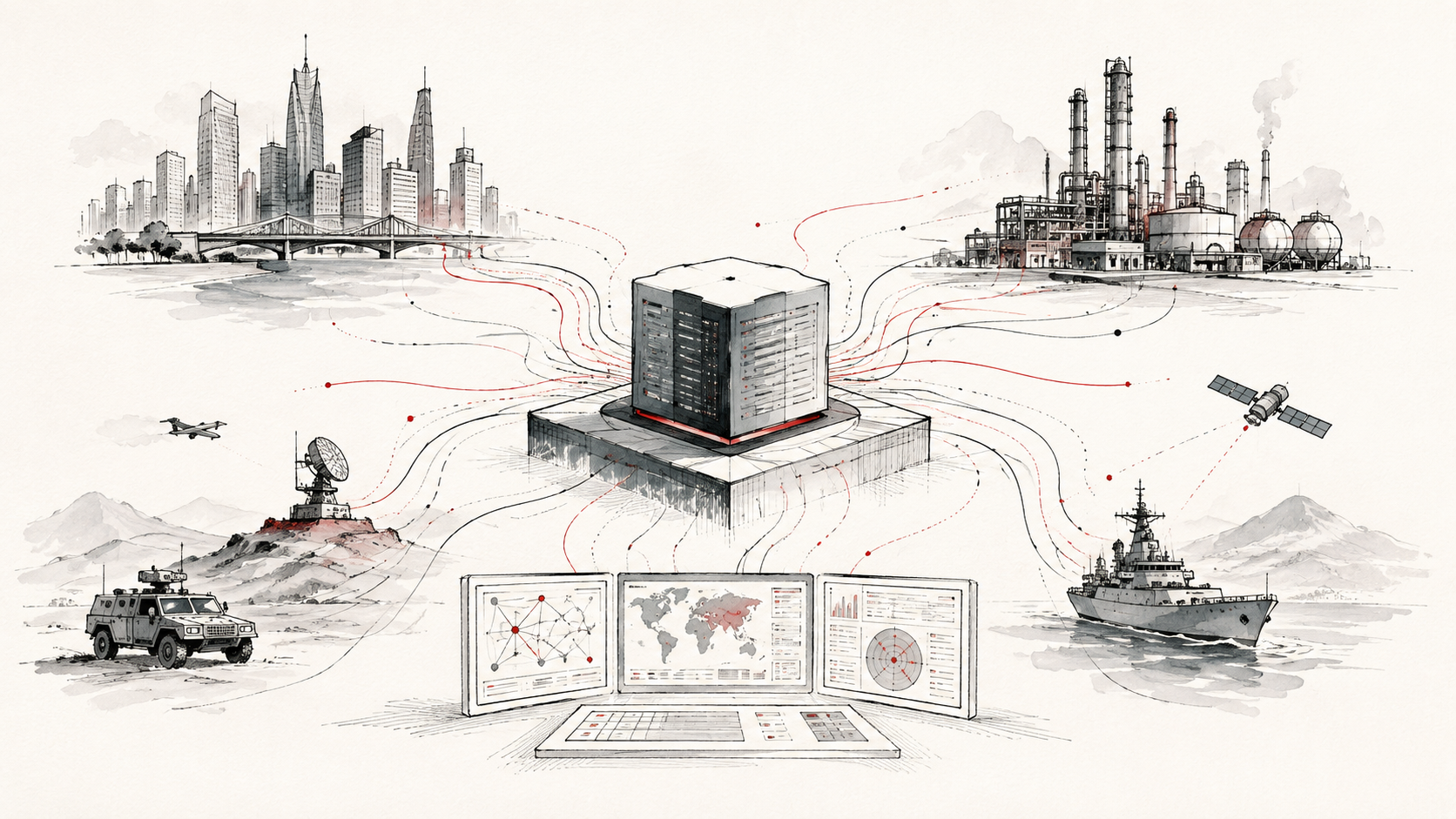
OpenAI, Anthropic, Google and others produce increasingly capable models. Palantir sits closer to the layer where those models are allowed to interact with an institution's actual data, permissions, workflows and physical operations. Its Ontology maps the objects and relationships inside an organization. AIP then allows artificial intelligence to operate within that governed environment.
That distinction becomes more valuable as models become cheaper and more interchangeable. If intelligence itself commoditizes, the scarce resource may shift from the model to the enterprise context: which database is authoritative, who is allowed to see what, which action requires approval, what happens when an AI recommendation conflicts with safety rules, and how every decision is audited later.
This is especially important in defense, healthcare, manufacturing, banking and critical infrastructure. A consumer can tolerate an AI assistant occasionally hallucinating. A weapons system, refinery, hospital or bank cannot deploy autonomous decisions under the same standard.
The U.S. commercial engine is the number I keep returning to
U.S. commercial revenue grew 149% year over year and 28% quarter over quarter to $764 million. Palantir now expects more than $3.424 billion of U.S. commercial revenue for all of 2026, representing at least 134% growth.
More importantly, the bookings data suggest this is not simply revenue recognition from old deals. Palantir closed $3.373 billion of total contract value in the quarter, up 49%. U.S. commercial TCV reached a record $2.132 billion, up 153%. U.S. commercial remaining deal value climbed 124% to $6.238 billion.
Those numbers matter because revenue is backward-looking. Remaining deal value is imperfect, but it gives a view into the contractual pipeline that has not yet become revenue.
The company closed 220 deals worth at least $1 million, 98 worth at least $5 million and 73 worth at least $10 million in the quarter. This is one of the lesser-discussed facts in the Palantir story. The business is not merely adding logos. It is creating a rapidly expanding population of very large contracts.
A strange sales model: fewer salespeople, larger contracts
Alex Karp has emphasized that Palantir operates with a remarkably small traditional sales force – he described it as roughly 70 people in recent commentary. One should treat executive rhetoric with healthy skepticism, especially when the comparison is designed to dramatize AI-driven efficiency. But the broader point is interesting.
Palantir historically sold through engineers and deployment teams rather than a huge army of conventional account executives. AIP bootcamps compressed that process: potential customers bring real data and use cases into intensive workshops, and Palantir attempts to demonstrate operational value quickly.
If this method scales, the economics are powerful. Software companies often spend 30% or more of revenue on sales and marketing to maintain growth. Palantir's model suggests that product-led proof and technically embedded teams can reduce the amount of conventional selling required.
There is also a risk. A process that works beautifully with highly motivated early adopters may become less efficient when Palantir reaches more ordinary enterprises. What looks like a revolutionary sales architecture at 1,000 customers can become a bottleneck at 10,000.
Government is no longer the boring half of the story
U.S. government revenue rose 90% to $809 million. This is striking because a few years ago government growth was often the slower, steadier piece of the company while investors waited for commercial adoption.
The geopolitical environment has changed. Defense departments increasingly view software, autonomy, targeting, logistics and data integration as part of the weapons system itself. Palantir's roots in intelligence and defense – once treated as a concentration problem – have become strategically fashionable.
The competitive advantage here is partly technical and partly institutional. Government procurement moves slowly, security clearances matter, systems must function in disconnected or classified environments, and integration often becomes deeply embedded. A competitor cannot necessarily replace a mission-critical platform by offering a prettier interface and a 20% discount.
But government revenue carries its own risks: election cycles, procurement disputes, budget changes, political controversy and public scrutiny. Palantir's proximity to defense and intelligence is both a moat and a permanent source of headline risk.
Sovereign AI may be Palantir's most important new narrative – and its most subtle risk
The company increasingly frames its product around “AI sovereignty”: customers should control their data, infrastructure and operational decisions rather than donating their most valuable information to a third-party model provider.
I understand why this resonates. Corporations are becoming aware that their proprietary data may be more valuable than access to any single model. Governments are even more sensitive. A country does not want military or intelligence workflows dependent on a foreign black box that can be altered, restricted or switched off.
Yet sovereign AI contains a paradox. The more Europe, the Middle East and Asia care about technological sovereignty, the more local governments may prefer domestic software companies. The concept that makes Palantir attractive in the United States can make an American vendor politically uncomfortable elsewhere.
This matters because the current growth is heavily U.S.-centric. Palantir can become a phenomenal company with a dominant U.S. franchise, but a valuation approaching half a trillion dollars ultimately invites questions about global scale.
Retention says customers are spending much more after they arrive
Management reported net dollar retention of 157% in the quarter. In simple terms, the same customer base is spending dramatically more over time, before counting entirely new customers. That is one of the best signals a software company can produce because it implies that initial deployments expand.
This is exactly what the Palantir bull case needs. The company does not need every bootcamp to become a giant contract immediately. It needs a small deployment to prove value, then spread into more departments, workflows and use cases.
Total remaining deal value reached approximately $13.1 billion, up 83% year over year, while remaining performance obligations were about $4.9 billion, up roughly 103%. The distinction matters: RDV is broader and can include contractual value beyond what accounting rules classify as RPO. I prefer RPO when I want stricter accounting visibility, but both are moving in the right direction.
The balance sheet is almost absurdly clean
Palantir ended June with $9.2 billion of cash, cash equivalents and short-term U.S. Treasury securities. Capital expenditure in Q2 was only about $14.6 million. This is one of the most attractive structural properties of enterprise software: when the product is built, an additional dollar of revenue requires very little physical capital.
Cash from operations was $1.216 billion in the quarter. Adjusted free cash flow was $1.220 billion because the company's definition adds back payroll taxes related to stock-based compensation and subtracts capex. Management now expects $4.5–$4.7 billion of adjusted FCF for 2026.
At the midpoint, $4.6 billion sounds enormous. It is. But valuation turns an enormous number into a surprisingly modest yield.
At $175, valuation becomes the entire conversation
As of August 11, Palantir traded around $175 per share, giving it a market capitalization of roughly $450 billion. Against 2026 revenue guidance of approximately $8.154 billion, the stock trades at about 55 times current-year sales.
Subtract the $9.2 billion of cash and Treasury securities and the enterprise value is still around $441 billion – roughly 54 times sales. Using the midpoint of adjusted free-cash-flow guidance, the equity trades near 98 times adjusted FCF, equivalent to an adjusted FCF yield of about 1%.
The current trailing P/E is around 150. These are not valuation metrics that leave room for ordinary excellence.
Why a 55x sales multiple is so difficult
Suppose Palantir grows from roughly $8.15 billion of 2026 revenue to $30 billion several years from now. That would be an extraordinary achievement. Assume further that the company converts 35% of revenue into sustainable free cash flow. That produces $10.5 billion of FCF.
If the market then values the mature company at 35 times FCF – still a premium multiple – the business would be worth roughly $368 billion. That is below today's market capitalization.
This example is intentionally simplistic. Palantir could reach $40 billion or $50 billion sooner. Its FCF margin could exceed 40%. A dominant AI operating layer might retain a multiple above 35x for a long time. But the exercise exposes the burden embedded in the stock price: spectacular corporate outcomes do not automatically produce spectacular shareholder returns when the starting valuation is extreme.
Three scenarios I use instead of pretending I know the exact DCF
| Scenario | 2030 Revenue | FCF Margin | What must happen |
|---|---|---|---|
| Bear | $20–24bn | 30–35 % | Growth normalizes fast; international adoption disappoints |
| Base | $30–35bn | 35–40 % | U.S. commercial remains elite; government compounds strongly |
| Bull | $45bn+ | 40 %+ | Palantir becomes a global default layer for operational AI |
In the bear case, today's valuation is extremely vulnerable. In the base case, the company can grow into the valuation, but returns depend heavily on what multiple the market is willing to pay in 2030. In the bull case, the current price can still look cheap – but the bull case requires Palantir to become far larger than today's software category suggests.
This is why I resist two simplistic statements: “Palantir is too expensive, therefore it must fall,” and “Palantir is growing 93%, therefore valuation does not matter.” Both ignore how compounding works.
The stock-based compensation debate is changing, not disappearing
Palantir recorded $265 million of stock-based compensation in Q2, up from roughly $160 million a year earlier. In absolute terms that is a large increase. As a share of revenue, however, SBC declined from roughly 16% to about 14% because revenue grew much faster.
This is the right direction. I still treat SBC as a real economic expense. Shares given to employees are not free simply because no cash leaves the bank. They dilute the claim of existing owners.
The good news is that diluted weighted-average shares were roughly 2.569 billion, only modestly above the year-earlier level. That suggests dilution is becoming less destructive than it was in Palantir's early public years. I would keep watching this carefully because a business can produce enormous corporate value while shareholders capture less of it if the share count expands aggressively.
The strange GAAP profit margin deserves a second look
GAAP net income was $1.062 billion, a 55% net margin – actually higher than the 47% operating margin. That is unusual. Part of the explanation lies below operating income: Palantir earns interest on its enormous Treasury portfolio and recorded other income. The tax provision in Q2 was also relatively small.
For valuation, I would therefore not simply annualize the 55% net margin and declare the stock cheaper than it looks. The operating margin is the cleaner signal of software economics. Interest income is real, but it depends on cash balances and rates; tax rates will normalize over time.
This is a small accounting detail, but it matters precisely because investors are tempted to extrapolate every extraordinary number in an extraordinary quarter.
What competitors actually threaten Palantir?
I do not think the most dangerous competitor is one company. The threat is decomposition.
A large enterprise can buy models from OpenAI or Anthropic, data infrastructure from Snowflake or Databricks, cloud capacity from Microsoft, Amazon or Google, and orchestration/security tools from a variety of vendors. The bearish question is whether enough customers can assemble these components internally at lower cost than buying Palantir's integrated stack.
The bullish response is that integration is precisely the hard part. A company does not create operating value merely by having a model endpoint. Someone has to map data, permissions, workflow logic, legacy systems and governance. Palantir has spent years doing that in unforgiving environments.
I suspect both arguments will be true. Sophisticated technology companies may build more in-house. Heavily regulated or operationally complex organizations may prefer a platform that already solves the integration layer.
International weakness is the risk I would not dismiss
The U.S. has become such a powerful engine that weak international growth can disappear inside consolidated numbers. I do not want to ignore it.
Europe has stricter procurement politics, strong privacy concerns and a growing preference for sovereign technology. Local competitors can use exactly the same sovereignty language against Palantir. If the company cannot translate its U.S. commercial success into Germany, France, the U.K., the Middle East and Asia at scale, its long-term addressable market is smaller than today's valuation assumes.
This does not mean international revenue must suddenly grow 100%. It means I want to see evidence that Palantir's product advantage survives outside the cultural and political environment where it is strongest.
What could still drive the stock materially higher?
The first catalyst is continued triple-digit U.S. commercial growth. If Palantir can sustain anything close to 100% on an increasingly large base through 2027, current valuation ratios compress remarkably quickly.
The second is international acceleration. A few large sovereign-AI wins could alter the market's perception of geographic concentration.
The third is continued margin expansion without higher dilution. A company growing 70–80% with a 50% GAAP operating margin deserves a valuation framework that looks different from ordinary SaaS.
The fourth is product expansion. If AIP becomes a control layer across multiple foundation models rather than a platform tied to one AI wave, Palantir's relevance could grow as models themselves commoditize.
What could break the story?
1. Growth normalizes faster than the multiple
This is the clearest risk. A stock at 55x sales can fall sharply even if revenue still grows 40%.
2. Large customers push back on pricing
Palantir's value proposition is strong when deployments produce measurable savings or revenue. As adoption broadens, not every customer will accept premium economics indefinitely.
3. Model providers move down the stack
OpenAI, Anthropic, Microsoft, Google and others have strong incentives to own more of the enterprise workflow. Palantir's integration layer is valuable partly because the AI stack is fragmented. Consolidation could reduce that advantage.
4. Political backlash
Defense, immigration, intelligence and policing contracts expose Palantir to controversies that ordinary business software companies do not face.
5. Key-person and cultural risk
Alex Karp is deeply associated with Palantir's identity, strategy and public narrative. Founder-led intensity can be an advantage, but it creates concentration of culture and communication around a small group of leaders.
The lesser-known number I care about most: capital intensity
Palantir spent only about $14.6 million on property and equipment in Q2 while generating nearly $1.94 billion of revenue. That is an extraordinary ratio. The company can scale without building factories, buying fleets or carrying large inventories.
This explains why revenue growth can translate into cash so quickly. It also explains why the valuation is so high: markets pay enormous premiums for businesses that can reinvest primarily through people and software rather than physical capital.
The catch is that software moats can erode faster than physical moats. A transformer factory takes years to replicate; software can sometimes be displaced in a product cycle. Palantir therefore combines beautiful capital economics with a need for continuous technological relevance.
What I would watch every quarter
I would track five numbers before I read the CEO letter: U.S. commercial growth, net dollar retention, U.S. commercial RDV, GAAP operating margin and diluted share count. Together they tell me whether customers are expanding, the pipeline is durable, the business is scaling and shareholders are actually retaining the economics.
I would then look at international growth and government concentration. Finally, I would compare adjusted free cash flow with GAAP cash generation rather than accepting any non-GAAP metric without reconciliation.
My conclusion: easier to believe, harder to buy
Palantir is becoming one of the rare companies where the operating results are more extreme than the promotional language. Ninety-three percent revenue growth, 149% U.S. commercial growth, 47% GAAP operating margins, 157% net dollar retention and a $6.2 billion U.S. commercial remaining deal value are not theoretical advantages. They are evidence of a platform enjoying a remarkable moment.
I no longer think the interesting debate is whether Palantir has a real moat. It appears to have one in several mission-critical environments. The debate is how large that moat can become globally and how much an investor should pay before the outcome is known.
At roughly $450 billion of market capitalization, the price asks for an extraordinary future. That does not make the stock uninvestable. Great companies repeatedly surprise people who believe a high multiple is the same thing as a short thesis. But the margin of safety is mathematical, not emotional. At 55 times sales, execution must remain exceptional.
Palantir / SEC – Q2 2026 earnings release, August 3, 2026
Palantir Investor Relations
Palantir – Q2 2026 CEO Letter
Palantir Q2 2026 Business Update and earnings call.
Market price and capitalization data around August 11, 2026.