
CoreWeave doubled quarterly revenue, ended June with roughly $104 billion of backlog and added more than $25 billion of new customer commitments in early Q3. Demand is not the problem. The problem is what it costs to satisfy that demand: $9.4 billion of Q2 capital expenditure, $640 million of net interest expense and a $626 million net loss. This may be the purest public-market expression of AI infrastructure scarcity – and one of the least forgiving balance sheets in the trade.
There are two ways to invest in an industrial revolution. You can own the elegant part – the interface, the software, the model people touch. Or you can own the machinery underneath it.
CoreWeave is the machinery.
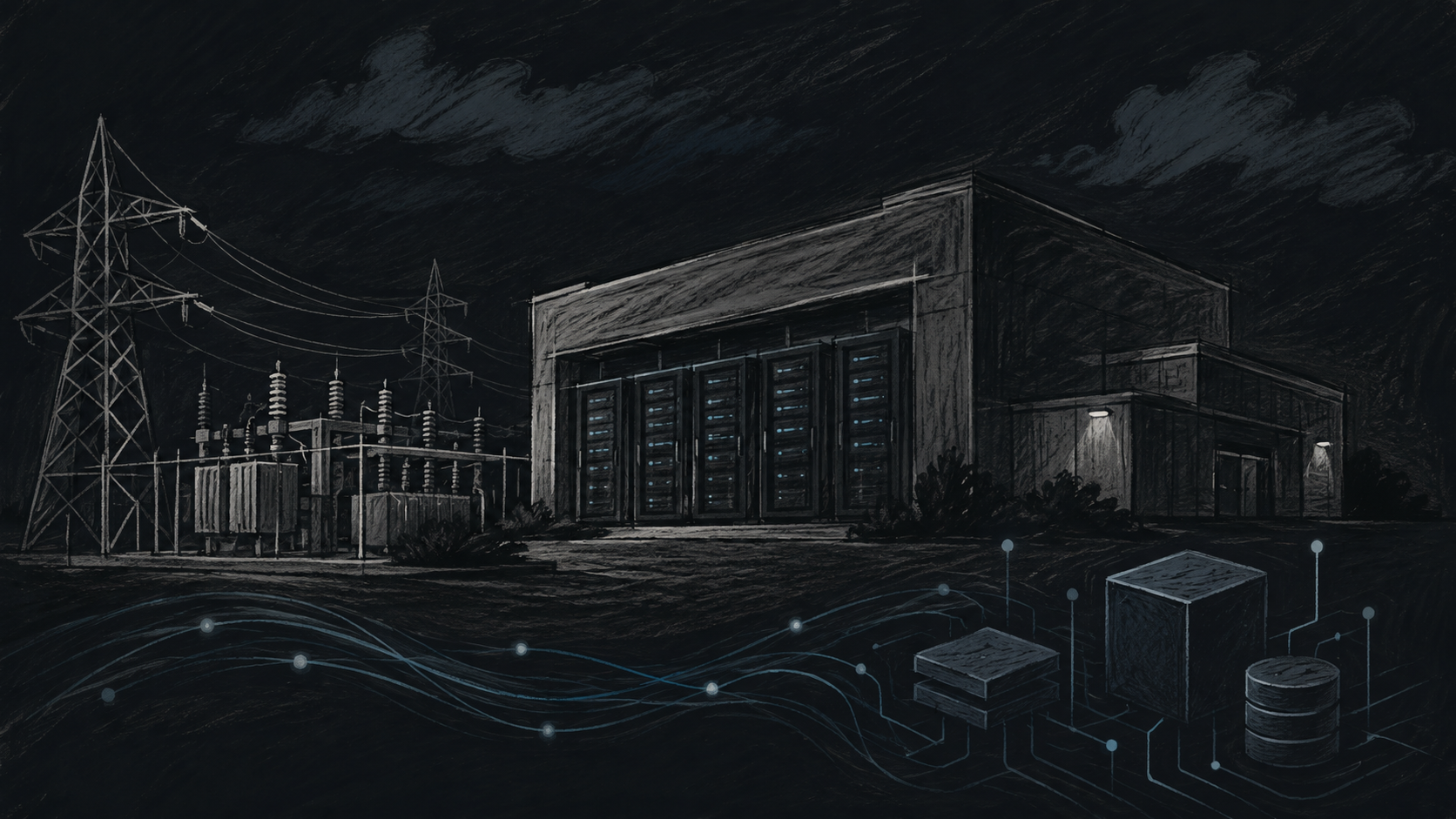
The company buys extraordinary amounts of AI computing equipment, secures extraordinary amounts of electricity, builds specialized data-center capacity and rents that capacity to customers who currently want more compute than the industry can deliver. Artificial intelligence may look weightless on a smartphone screen, but CoreWeave reminds me that behind every token sits steel, copper, silicon, substations, cooling systems and debt.
That is precisely why I find this business more interesting than a simple “AI cloud” label suggests. CoreWeave is producing some of the strongest demand indicators I have seen in public technology markets while simultaneously exposing investors to one of the most capital-intensive growth models in modern tech. The bull case and the bear case are not different stories. They sit on adjacent lines of the same financial statements.
Q2: product-market fit is no longer the question
Second-quarter revenue reached $2.575 billion, up from $1.212 billion a year earlier – an increase of approximately 112%. Revenue backlog was roughly $104 billion as of June 30. The company also said that this figure excludes more than $25 billion of net new customer commitments signed in early Q3.
That scale of backlog is unusual even among rapidly growing infrastructure providers. It tells me that CoreWeave is not building capacity speculatively and then searching for tenants. Customers are committing to capacity before much of it is operational.
The physical numbers are equally remarkable. Active power expanded by almost 500 megawatts during Q2 to 1.5 gigawatts. Contracted power reached approximately 3.7 gigawatts. The difference between those figures is a rough map of the capacity pipeline still to be brought online.
More than half of the backlog is tied to contracts where delivery has already started. That distinction matters because it reduces the proportion of the backlog that exists only as a future promise. Still, the company must build a very large amount of infrastructure before the full contracted revenue can become cash.
The most important AI metric may be megawatts, not GPUs
Investors naturally focus on Nvidia accelerators because GPUs are the most visible scarce resource in the AI boom. Yet a GPU without electricity, networking and cooling is just an expensive piece of hardware. The deeper constraint is increasingly power.
CoreWeave's 3.7 gigawatts of contracted power illustrate the point. A gigawatt cannot be downloaded. It requires land, grid interconnections, substations, transformers, permits, cooling infrastructure and construction. In many regions, the wait for a new high-voltage connection is measured in years rather than months.
This gives operators with already-secured sites a genuine advantage. The moat is not purely technological; it is partly physical and bureaucratic. A competitor may raise billions tomorrow and still fail to reproduce a powered campus quickly enough.
Backlog is evidence of demand – not the same thing as cash
I like backlog, but I do not worship it. CoreWeave defines revenue backlog to include remaining performance obligations plus other amounts expected to be recognized under committed customer contracts, subject to delivery and service availability.
That final clause is important. In a conventional SaaS business, much of the infrastructure already exists. A new subscription can be served with tiny marginal capital requirements. CoreWeave often needs to build the underlying capacity first. Backlog is therefore both an asset and an obligation: it proves demand, but it also forces the company to spend.
This distinction becomes especially important when investors compare CoreWeave's backlog with its current market capitalization. A dollar of backlog is not a dollar of free cash flow. It must survive equipment depreciation, energy costs, construction costs and financing costs before it belongs to equity holders.
The line that changes the entire analysis: $640 million of quarterly interest
CoreWeave reported adjusted EBITDA of $1.510 billion in Q2, representing a 59% margin. Taken alone, that figure looks spectacular. It implies that operating capacity is highly cash-generative before depreciation, interest and certain adjustments.
Then I move down the income statement. GAAP operating loss was $49 million. Net interest expense was $640 million. Net loss was $626 million.
| Q2 2026 | Amount | What I see |
|---|---|---|
| Revenue | $2.575bn | Demand is exceptional |
| Adjusted EBITDA | $1.510bn | Strong economics before D&A and financing |
| D&A | $1.393bn | The hardware cost is enormous |
| GAAP operating loss | -$49m | Current scale has not yet produced operating profit |
| Net interest expense | -$640m | The capital structure absorbs real economics |
| Net loss | -$626m | Equity earnings remain negative |
This is why CoreWeave is not a normal software analysis. EBITDA can be useful, but it removes two costs that are central to the economic model: the wearing out of expensive hardware and the price paid to finance it.
Depreciation is not a fake cost when your assets are GPUs
Technology investors often treat depreciation as a harmless accounting add-back. That can make sense for assets whose useful life is much longer than the accounting schedule. I am far less comfortable doing that with frontier AI hardware.
CoreWeave recorded approximately $1.393 billion of depreciation and amortization in Q2. The economic question behind that number is simple: how much rent will today's hardware earn after the next two generations of accelerators arrive?
An Nvidia Blackwell system will not become useless when Rubin is deployed. Older GPUs can migrate toward inference, fine-tuning or less demanding workloads. But the price of a compute hour generally changes as faster hardware becomes abundant.
So depreciation is not merely historical accounting. It is an imperfect attempt to measure a real economic race against technological obsolescence. For CoreWeave, I care much more about normalized returns after depreciation than about EBITDA in isolation.
$35–39 billion of capex turns AI into heavy industry
CoreWeave spent $9.4 billion on capital expenditures in Q2, after roughly $6.8 billion in Q1. Management raised its full-year 2026 capex outlook to $35–39 billion from $31–35 billion.
That figure is extraordinary relative to expected revenue. It means the company is spending today's capital to build several years of tomorrow's revenue base.
The bullish interpretation is straightforward. Much of the expansion is effectively pre-sold. Customers are signing long-term commitments, near-term capacity is scarce and new agreements are reportedly being signed on increasingly favorable terms. If CoreWeave can finance equipment at a lower cost than the long-term cash yield generated by those contracts, enormous value can be created.
The bearish interpretation is equally straightforward. A company that must continuously raise tens of billions of dollars remains exposed to the mood of capital markets. Demand can be excellent and the equity can still suffer if debt becomes too expensive.
The strangest part of the valuation: fast growth can hide weak equity economics
CoreWeave traded around $90 after the latest session, implying a market capitalization of roughly $48 billion. At first glance, that does not look obviously expensive relative to a company whose quarterly revenue has more than doubled and whose annual revenue is moving into the low-teens billions.
But sales multiples are misleading here. A dollar of CoreWeave revenue requires vastly more capital than a dollar of Palantir or Adobe revenue. The correct enterprise value also includes substantial debt, making the real price of the operating assets materially higher than the equity market capitalization.
The long-term question is not “What revenue multiple should a 100%-growth company trade at?” The question is “How much free cash remains for shareholders after the equipment has been replaced and the lenders have been paid?”
Nvidia: strategic advantage and structural dependency
CoreWeave's history is unusual. The business emerged from cryptocurrency mining, where the founders learned to manage large fleets of GPUs as economic assets. When generative AI demand exploded, that experience suddenly became extremely valuable.
The company developed a close relationship with Nvidia and repeatedly became an early deployer of new systems. In Q2 it announced that it had completed the industry's first bring-up and validation of Nvidia Vera Rubin NVL72.
Being early matters. Frontier AI laboratories are not buying generic compute. They are trying to access the newest architecture at scale before competitors do. A few months of earlier availability can translate into meaningful pricing power.
Yet this relationship is also a dependency. If alternative accelerators from AMD, Google, Amazon or custom silicon gain share, CoreWeave must prove its platform offers value beyond privileged access to Nvidia hardware.
The strategic escape route: become a platform rather than a landlord
This is the part of the thesis I think investors should watch most carefully. CoreWeave is adding products that sit above raw GPU rental. CoreWeave Interconnect links customers privately to other hyperscale clouds. SUNK Anywhere extends its Kubernetes platform across broader AI environments. LOTA is designed to improve cross-cloud data access. The company is also launching agentic-AI and observability tools.
The logic is clear. Hardware rental tends to commoditize over time. Software and orchestration can create switching costs. If customers begin to think of CoreWeave as the control layer for AI infrastructure rather than simply a place to find scarce Nvidia clusters, the quality of revenue improves.
That is how CoreWeave could eventually earn economics closer to software despite owning enormous physical infrastructure.
Customer concentration must continue to fall
Microsoft historically represented a very large portion of CoreWeave's revenue. The customer roster is broadening across hyperscalers, AI labs and enterprises. The company highlighted customers and expansions across industrial, financial and AI-native workloads.
This diversification matters because the backlog is only as resilient as its counterparties. A $100 billion backlog spread across many strong customers is qualitatively different from one dominated by a handful of contracts.
It also matters for workload mix. Training frontier models can create enormous but lumpy contracts. Enterprise inference may produce smaller individual contracts but a broader and more recurring demand base. A mature CoreWeave should ideally contain both.
Financing is becoming part of the competitive moat
CoreWeave completed a $3.1 billion delayed-draw term loan backed by high-performance computing infrastructure. It also raised more than $10 billion of unsecured debt and convertible bonds and received a $1 billion strategic investment from Jane Street.
This is not corporate-finance trivia. The ability to transform customer commitments into financeable assets is a core operating capability.
A customer signing a multi-billion-dollar compute agreement needs confidence that the provider can build what was promised. That means CoreWeave's relationships with banks and debt investors are part of its competitive position.
The danger is obvious as well. If lenders become skeptical of residual GPU values, customer concentration or AI demand, the cost of capital can change quickly. A business that looks spectacular at a seven-percent financing cost can look very different at twelve percent.
A metric I would like to see: revenue per active megawatt
CoreWeave reports active and contracted power, but I would love to see a standardized revenue-per-active-megawatt metric over time. For an infrastructure operator, this could become as useful as same-store sales in retail.
If active power doubles while revenue rises only 50%, incremental capacity is being monetized less effectively. If revenue grows faster than active power, utilization, pricing or workload mix is improving.
The current gap between 1.5 GW active and 3.7 GW contracted is enormous. As that capacity comes online, the relationship between megawatts and revenue will tell us whether the AI compute market remains scarce or begins to commoditize.
Three valuation scenarios
| Scenario | What happens | Equity implication |
|---|---|---|
| Bear | Compute pricing compresses, financing remains expensive, hardware depreciates quickly | Debt captures much of the economics |
| Base | Backlog converts, GAAP margin turns positive, interest burden grows slower than revenue | equity begins to benefit from scale |
| Bull | CoreWeave becomes the default independent AI infrastructure platform | today's capex creates a massive durable franchise |
In the bear case, the company can continue growing revenue while shareholders still earn poor returns. This is the counterintuitive part of leveraged infrastructure: growth is not automatically value creation.
In the base case, the current buildout begins to mature. Utilization rises, operating margins expand, financing costs fall as the business establishes a longer credit history, and the gap between EBITDA and equity cash flow narrows.
In the bull case, CoreWeave becomes the independent alternative to hyperscale clouds for AI workloads. Its software layer becomes sticky, customer concentration declines and the company gains structural buying and financing advantages that competitors cannot easily reproduce.
Why Q2 may genuinely be an inflection point
Management described the quarter as a point where scale began to translate into operating leverage. Adjusted operating income was $128 million, or five percent of revenue. GAAP operating margin remained negative two percent.
The sequence bulls need is fairly simple: build capacity, fill capacity, let revenue grow into the fixed cost base, then refinance at better rates. If CoreWeave can move from negative GAAP operating margins into sustained double-digit operating profitability while keeping utilization high, the equity story changes dramatically.
But I want to see the shift in GAAP numbers. Adjusted EBITDA alone is not enough when depreciation and financing are central to the business.
The hardest risk to model: residual value
No spreadsheet can confidently tell me what a Blackwell cluster will be worth in four years. The answer depends on future Nvidia architectures, AMD, custom silicon and how quickly inference becomes cheaper.
Older GPUs will retain useful workloads. AI demand may expand so quickly that even less efficient hardware remains economically valuable. But rental prices can fall as performance per dollar improves.
That is why residual-value assumptions are so important. A lender sees collateral. I see a portfolio of future compute hours whose price is under constant attack from technological progress.
The lesser-known cultural advantage of CoreWeave
The company's roots in crypto mining may explain why it moved faster than conventional cloud providers. Miners learned to think about GPUs as financial assets: acquisition cost, electricity cost, utilization, hardware efficiency, resale value and financing.
That mentality translated surprisingly well into AI infrastructure. The founders recognized that scarce GPUs could be deployed into higher-value workloads and built an organization comfortable with rapidly changing hardware economics.
The question now is whether the same aggressive capital instincts that worked at a smaller scale remain disciplined when annual capex reaches tens of billions.
What would make me more bullish?
I would want four things. First, positive GAAP operating margins. Second, net interest expense growing materially slower than revenue. Third, a falling concentration of revenue among the largest customers. Fourth, evidence that CoreWeave's software and orchestration products deepen customer relationships beyond simple GPU rental.
I would also watch pricing on new contracts. Management says near-term capacity is effectively sold out and that new agreements are being secured on increasingly favorable terms. If that remains true while active power grows rapidly, CoreWeave has genuine scarcity power.
What would make me more bearish?
The most dangerous combination would be falling compute prices and rising financing costs. That is the classic squeeze for a leveraged asset business: the yield on the asset falls while the cost of capital rises.
I would also worry about delays in grid connections, customer renegotiations, a slowdown in backlog growth or a faster-than-expected move toward proprietary accelerators at hyperscalers.
What I will watch every quarter
My dashboard is simple: revenue backlog, active power, contracted power, GAAP operating margin, adjusted operating margin, depreciation, net interest expense, capex and customer concentration.
I would add one qualitative question: Is CoreWeave becoming more important to customers because of its platform, or merely because the latest Nvidia hardware is scarce? That distinction will determine whether the company earns durable platform margins or cyclical infrastructure margins.
My conclusion
CoreWeave may be the most honest AI stock in the market because it forces investors to confront both sides of the boom. The demand is real. Customers are signing tens of billions of dollars of commitments. Power is scarce. Frontier compute is scarce. Revenue more than doubled.
But the physical bill behind AI is equally real. CoreWeave spent $9.4 billion on capex in one quarter, paid $640 million of net interest and recorded a $626 million net loss. The company is attempting one of the fastest infrastructure expansions in corporate history while the hardware it buys evolves at extraordinary speed.
I do not see a simple bubble and I do not see a simple bargain. I see a business whose operating opportunity may be exceptional but whose capital structure leaves very little room for execution mistakes.
If CoreWeave can turn today's construction frenzy into a durable cloud platform with positive GAAP margins, lower financing costs and sticky enterprise workloads, the current equity value can look surprisingly modest. If compute becomes commoditized before the balance sheet matures, lenders will capture more of the economics than shareholders.
CoreWeave Investor Relations – Q2 2026 Results, August 11, 2026
Reuters – CoreWeave raises 2026 capital-spending plan, August 11, 2026.
Market data: CRWV approximately $90 per share / ~$48bn market capitalization around August 12, 2026.