
The Kapital · Global Deep Dive · United States · 20 August 2026
Tesla’s purpose-built Cybercab is moving closer to the road. Reuters reported this week that employee rides in Austin could begin in August, a meaningful step toward a public launch of the steering-wheel-free vehicle. The timing matters because Tesla’s valuation increasingly depends on autonomy economics rather than conventional car economics. In the latest quarter deliveries recovered sharply, but automotive margins remained weak, capital spending surged and free cash flow turned negative. Cybercab therefore has to become more than a product demonstration. It has to become a high-return network.
I think Tesla is easiest to misunderstand when investors try to force it into one category. If I value it only as an automaker, the stock looks extraordinarily expensive. If I value every ambition in autonomy, robotics, energy storage and AI as already successful, the valuation becomes almost impossible to falsify. The useful middle ground is to ask what each business has actually proven and what the market price requires next.
Cybercab is now the most important bridge between those two worlds. A robotaxi network could transform a one-time vehicle sale into recurring, software-like revenue generated from each mile. It could also turn out to be capital intensive, operationally complex and regulated city by city. The economics depend on utilization, insurance, cleaning, maintenance, charging, downtime and local permissions—not only on whether a car can drive itself through a demo route.
Cybercab is finally becoming an operating question
On August 17, Reuters reported that Tesla was preparing Cybercab rides for employees in Austin as soon as August. The purpose-built vehicle has no steering wheel or pedals, so its commercial relevance depends entirely on autonomous operation. This is qualitatively different from selling Full Self-Driving as a supervised driver-assistance package in a consumer vehicle.
That distinction is why I take the rollout seriously even if the initial fleet is small. Tesla does not need thousands of Cybercabs on day one to prove the thesis. It needs to demonstrate that the operating system can move from constrained pilots toward repeatable deployments without a human safety model hiding the true cost structure.
The car business recovered in volume, not in economics
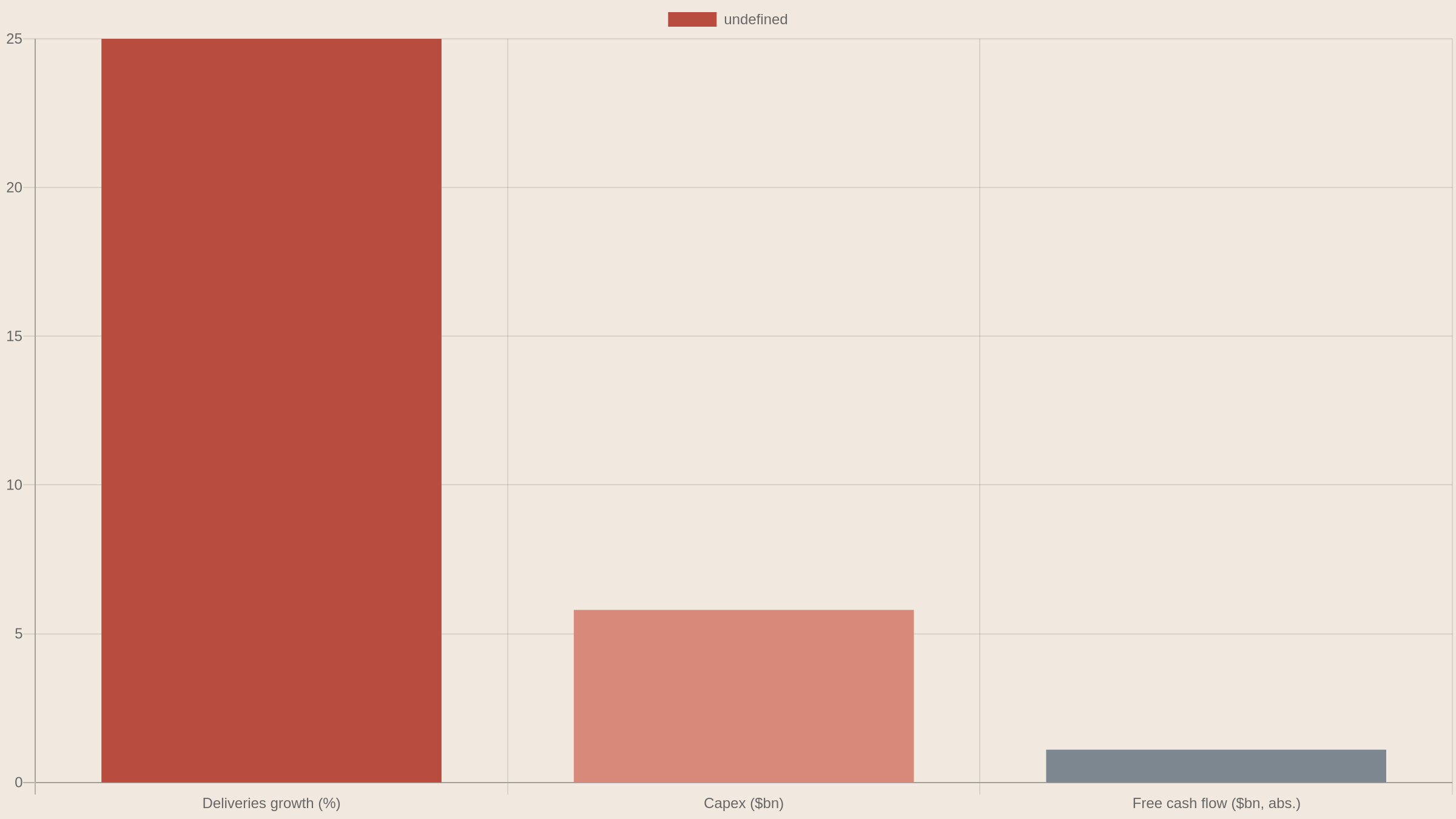
Tesla delivered 480,126 vehicles in the second quarter, up 25% from a year earlier and better than many investors expected. Revenue reached $28.24 billion. Those figures matter because the core automotive engine still funds much of Tesla’s expansion into AI, robotics and energy.
But the quality of the quarter was weaker than the headline delivery number. Adjusted earnings per share came in at $0.33 versus roughly $0.51 expected by analysts cited by Reuters. Automotive gross margin was 16.3%, below the roughly 18% consensus level. Average revenue per Tesla fell to about $42,730 from $45,345 a year earlier. Regulatory-credit revenue dropped to $146 million, roughly one-third of the prior-year level.
This is exactly why I refuse to extrapolate deliveries alone. A company can ship more vehicles and create less incremental value if pricing falls, incentives rise and the cost base expands faster than unit economics improve.
Different units shown together only to illustrate direction: delivery growth in percent; capex and free cash flow in billions of dollars.
The capital burden is now impossible to separate from the AI thesis
Capital expenditures reached $5.8 billion in Q2, more than double the level a year earlier, while free cash flow fell to negative $1.1 billion. Tesla expects 2026 capex above $25 billion as it invests in AI training infrastructure, autonomous driving, Cybercab manufacturing, energy storage and robotics.
I do not automatically dislike high capital spending. A company should spend aggressively when it sees high-return opportunities. The issue is that Tesla is asking investors to fund several unproven return curves at once. The same dollar of capex can support a factory expansion, a compute cluster, an Optimus line or a robotaxi network. These projects have very different risk and payback profiles.
The market is effectively assuming that some of those investments will produce economics superior to the traditional auto business. If robotaxi merely adds another capital-intensive fleet operation with mid-teens gross margins, the current valuation will be difficult to defend. If autonomy creates high utilization and recurring software revenue with much higher incremental margins, the story changes completely.
What robotaxi economics actually need to look like
I model a robotaxi business from the vehicle backward. The first variable is utilization: how many paid miles can one vehicle complete per day? The second is revenue per mile after promotions. The third is variable cost per mile—energy, tires, maintenance, cleaning, connectivity, insurance and customer support. The fourth is capital intensity: vehicle cost, charging infrastructure and fleet depots.
Then comes the most difficult variable: autonomy supervision. If Tesla needs remote operators to intervene frequently, the labor advantage narrows. If safety performance allows one operator to monitor many vehicles, unit economics improve rapidly. This is why disengagement-like operational metrics and intervention frequency matter more to me than a polished app interface.
There is also geographic density. A robotaxi network becomes more valuable when enough cars and riders are concentrated in the same market. Low density creates empty repositioning miles. High density can improve utilization and reduce wait times. Network economics therefore become city-specific long before they become national.
Illustrative index only. Tesla has not published the economics required for this scenario framework.
FSD subscriptions are the most important leading indicator
Tesla said active FSD subscriptions reached about 1.5 million, up 56% year over year. I consider that strategically important because it proves consumers are willing to pay recurring money for autonomy-related functionality even before true unsupervised robotaxi economics are established.
But I would not equate an FSD subscription with a robotaxi margin. The consumer supplies the vehicle, charging, parking and much of the operational overhead. In a company-operated Cybercab fleet, Tesla may own or finance far more of that burden. The revenue can be larger, but so can the denominator.
The upside is data and distribution. Millions of vehicles can collect driving data, and Tesla can update software across a huge installed base. This creates a feedback loop competitors with smaller fleets may struggle to match. The unanswered question is whether data scale translates into regulatory and safety performance fast enough.
Energy is quietly becoming the strongest non-auto proof point
Tesla deployed 13.5 GWh of energy storage in Q2, up from 8.8 GWh in Q1 and 9.6 GWh a year earlier. I pay attention to this because it is a reminder that Tesla’s non-automotive ambitions are not all equally speculative. Energy storage is already a real, scaled commercial business benefiting from grid demand, renewables integration and data-center power needs.
If I were separating Tesla into businesses, energy would receive a much higher probability of success than Optimus and a lower optionality discount than robotaxi. It can support the valuation, but at a roughly $1.4 trillion equity value it cannot carry the thesis by itself.
Why the market cap is the cleanest valuation lens
Traditional earnings multiples are not especially useful when Tesla is intentionally depressing near-term free cash flow to build new businesses. I therefore think in market-cap scenarios. The question is how much value the auto, energy, autonomy and robotics pieces can plausibly support together.
Bear case: about $900 billion
In my bear case the vehicle business remains profitable but structurally lower-margin, Cybercab expands slowly because of regulation and supervision costs, and robotics stays pre-commercial. Energy grows, but not enough to offset multiple compression. Tesla remains a uniquely valuable company, just not a $1.4 trillion one.
Base case: about $1.35 trillion
My base case assumes automotive volumes recover, margins stabilize in the high teens, energy remains a strong growth business and robotaxi becomes commercially real in several U.S. markets. I do not assume a nationwide autonomous monopoly. At this level the current valuation is roughly fair.
Bull case: about $2.0 trillion
The bull case requires autonomy to prove software-like economics: high utilization, low intervention rates, favorable regulation and meaningful recurring revenue per vehicle. Energy keeps compounding and Optimus becomes credible optionality rather than a story. In that world Tesla can justify a valuation well above today’s level.
Illustrative valuation scenarios, not price targets. Recent market capitalization is an approximate July/August 2026 reference.
The biggest risk is not technology. It is the gap between demonstration and economics
Investors often debate whether Tesla’s autonomy system will technically work. I think that is only half the question. A technology can work and still disappoint shareholders if the operating cost is higher than expected, rollout is slower, insurance is expensive or regulators require redundant safety processes.
The danger is especially high because Tesla’s stock already capitalizes a large amount of future success. A conventional automaker can surprise positively by improving margin from 8% to 10%. Tesla may need to create an entirely new profit pool just to defend its multiple.
That does not make the stock uninvestable. It changes the burden of proof. I want to see paid rides, expansion without geofenced fragility, intervention metrics, accident data, fleet utilization and contribution margin. Those are the numbers that will tell me whether Cybercab is an asset or merely a fascinating machine.
The five pieces of evidence Cybercab still owes investors
First, sustained Cybercab deployment in multiple cities without a large remote-supervision workforce. Second, evidence that the cost per paid mile falls as the fleet scales. Third, a return to positive free cash flow even while AI capex remains elevated. Fourth, stabilization of automotive gross margins without relying on regulatory credits. Fifth, FSD subscription growth that continues after any initial promotional push.
If Tesla delivers those five things, I would be willing to move more value from optionality into my base case. Today I still treat a large portion of robotaxi and Optimus value as probability-weighted rather than proven.
Where product excitement stops and stock value begins
Cybercab matters because it is the first Tesla product whose economic purpose depends almost entirely on autonomy. That makes the upcoming rollout one of the cleanest tests of the company’s post-automotive thesis.
The car business recovered in volume during Q2, but margins and free cash flow remind me why the stock cannot be justified by vehicle sales alone. Tesla is spending more than ever to create businesses that should, in theory, earn higher returns than manufacturing cars. The market already assumes at least part of that transition succeeds.
At roughly a $1.4 trillion recent market value, Tesla sits almost exactly around my base case. I would not call the stock cheap. I would call it unusually sensitive to evidence. Every meaningful city launch can move autonomy value out of the realm of narrative. Every quarter of negative free cash flow without clear robotaxi unit economics does the opposite.
Sources and data status
Data status: 20 August 2026. Tesla’s Cybercab rollout remains early and operational economics are not yet publicly established.
- Reuters: Tesla prepares Cybercab launch in August
- Reuters: Tesla Q2 cash burn, margins and AI capex
- Reuters: Tesla Q2 delivery record
This article reflects my own analysis and is not investment advice. Autonomy, regulatory approvals and valuation assumptions can change rapidly.