
Research basis: September 2026. WACC is one of those finance acronyms that can make a simple idea look far more intimidating than it is.
The weighted average cost of capital asks one central question: what return do the providers of capital require for financing this business?
That return matters because money has an opportunity cost. Equity investors can own another stock. Bond investors can lend to another issuer. Both groups demand compensation for risk. WACC combines those required returns into one company-level hurdle rate.
It is also one of the most sensitive inputs in a discounted cash-flow model. A seemingly small move from 8% to 9% can erase a large portion of estimated fair value, especially for businesses whose cash flows sit far in the future.
This guide explains the WACC formula, each component, a worked example, common errors and the deeper reason the number matters for stock valuation.
What does WACC stand for?
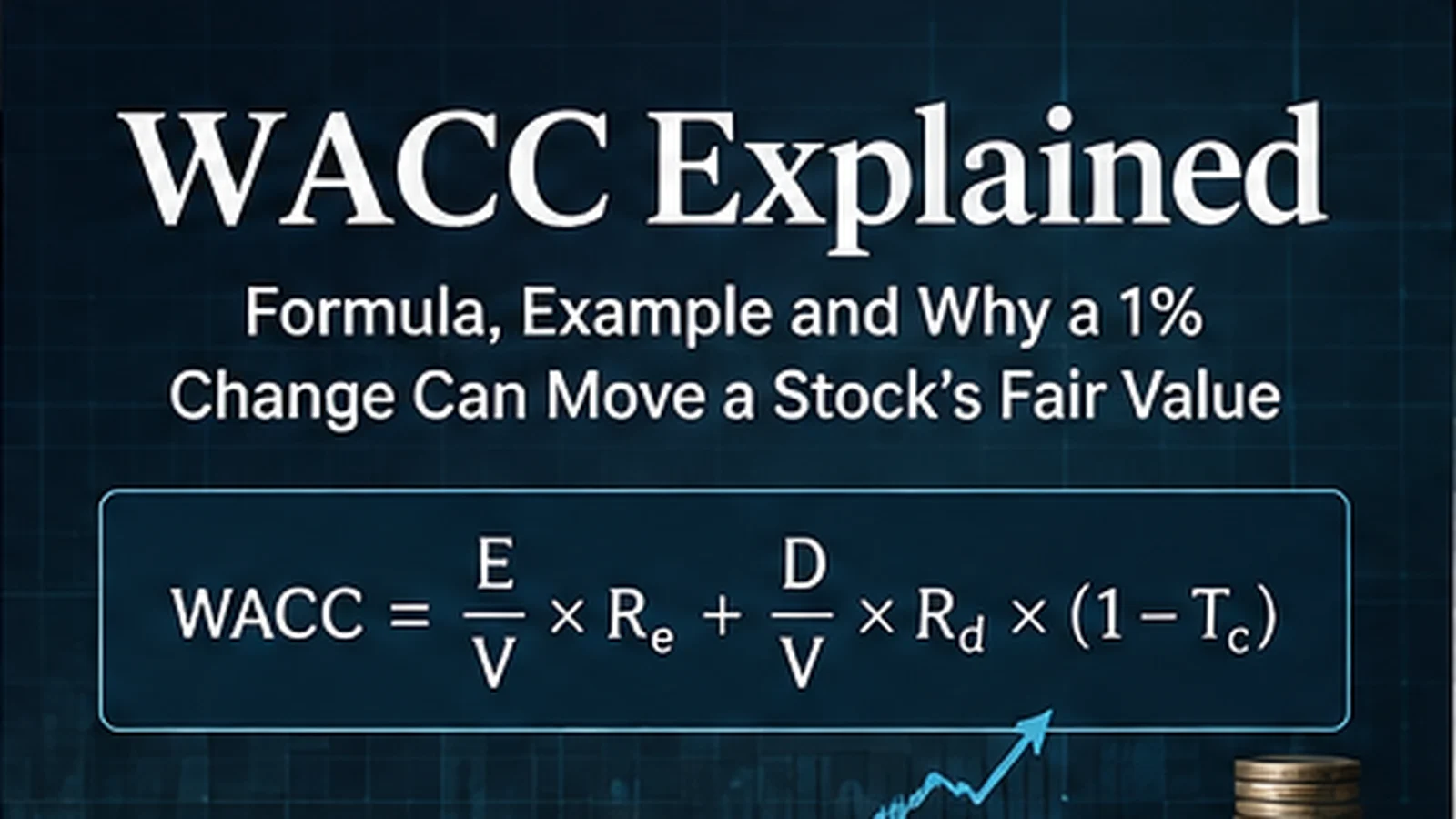
WACC = Weighted Average Cost of Capital.
In simplified form:
WACC = (Equity Weight × Cost of Equity) + (Debt Weight × After-Tax Cost of Debt).
Some companies also have preferred stock or other financing claims, which can be included as additional weighted components.
The word weighted is essential. A company financed 90% by equity and 10% by debt should not give debt and equity equal influence in the calculation.
Illustrative example only. Actual WACC depends on the company, market conditions, currency, capital structure and risk assumptions.
Why does WACC exist?
A business is usually funded by more than one group. Common shareholders supply equity capital. Banks and bondholders supply debt capital. Each group expects a return.
Debt is normally cheaper because lenders have contractual claims and often rank ahead of shareholders if the company fails. Equity is riskier because shareholders receive the residual value after other claims are satisfied.
WACC blends those costs into a single hurdle rate for the enterprise.
CFA Institute describes WACC as the cost of debt and equity capital used to finance a company’s assets. It is used internally to evaluate capital investments and externally as a critical valuation input.
Why WACC is the discount rate for FCFF
In a DCF model, the discount rate must match the cash flow being valued.
Free cash flow to the firm (FCFF) belongs to both debt and equity capital providers. Because WACC represents the required return of both groups, FCFF is discounted at WACC to estimate enterprise value.
Free cash flow to equity (FCFE) belongs only to common shareholders. It should therefore be discounted at the cost of equity rather than WACC.
Mixing FCFF with cost of equity or FCFE with WACC creates an internally inconsistent valuation.
Our DCF Valuation Explained guide shows how those pieces fit together.
The cost of equity
The cost of equity is the return shareholders require for owning the stock.
Unlike bond interest, it is not written into a contract. Investors infer it from market risk and company-specific exposure.
A common framework is the Capital Asset Pricing Model:
Cost of Equity = Risk-Free Rate + Beta × Equity Risk Premium.
In some cases analysts add a country risk premium, size premium or other adjustment, although every extra layer should have an economic rationale rather than being used simply to force a preferred valuation.
The risk-free rate
The risk-free rate is intended to represent the return on an investment with minimal default risk in the same currency as the cash flows being valued.
For a U.S. dollar valuation, analysts often begin with a U.S. Treasury yield. For euro cash flows, they should use a euro-denominated benchmark consistent with the valuation framework.
The currency matters more than the headquarters. A global company valued in dollars needs a dollar-consistent discount rate.
When risk-free rates rise, WACC usually rises unless some other component falls enough to offset the move. That is one reason higher bond yields compress equity valuation even when company earnings are unchanged.
The equity risk premium
The equity risk premium, or ERP, is the additional return investors demand for owning equities instead of a risk-free asset.
It is not directly observable. Analysts estimate it from historical returns, surveys or market-implied models.
Aswath Damodaran publishes regularly updated implied equity risk premium data and country risk estimates. The important lesson is not that one source owns the “correct” ERP. The lesson is that the assumption should reflect current market conditions and be applied consistently.
A valuation built with an ERP from a very different market regime can create fake precision.
What is beta?
Beta estimates how strongly a stock tends to move with the broader market.
A beta of 1.0 suggests market-like sensitivity. A beta above 1.0 implies greater historical market sensitivity. A beta below 1.0 implies less.
Beta is useful, but it is noisy. A company can change its business mix, leverage or cyclicality faster than a historical regression captures.
For comparable-company analysis, analysts often unlever peer betas to remove financing effects, take a representative industry beta and relever it to the target company’s capital structure.
This is more work, but it can be more economically stable than trusting one raw historical beta.
The cost of debt
The pre-tax cost of debt is the return lenders currently require to finance the company.
For a company with traded bonds, market yields can provide useful evidence. For a company without public debt, analysts may estimate a credit spread based on rating, leverage and interest coverage, then add that spread to a risk-free reference rate.
The historical coupon on an old bond is not necessarily the current cost of debt. What matters is the rate the company would face in today’s market for comparable borrowing.
Why the cost of debt is adjusted for taxes
Interest expense is generally tax deductible in many corporate tax systems. That means debt financing creates a tax shield.
The simplified after-tax cost of debt is:
After-Tax Cost of Debt = Pre-Tax Cost of Debt × (1 − Tax Rate).
If a company’s pre-tax debt cost is 6% and the relevant tax rate is 25%, the after-tax cost is approximately 4.5%.
But the tax shield only has value if the company can actually use it. A chronically loss-making firm may not receive the same immediate benefit.
Use market-value weights, not book-value weights
WACC is a market-based required return, so the capital weights should generally reflect market values.
If a company has $8 billion of market equity and $2 billion of market-value debt, the capital structure is approximately 80% equity and 20% debt for WACC purposes.
Using book equity from the balance sheet can badly misrepresent the economic financing mix, especially for companies whose stock price moved substantially since the equity was originally issued.
A complete WACC example
Assume a hypothetical company has:
- $8 billion market value of equity;
- $2 billion market value of debt;
- 10% cost of equity;
- 6% pre-tax cost of debt;
- 25% tax rate.
Equity weight = 80%.
Debt weight = 20%.
After-tax debt cost = 6% × (1 − 25%) = 4.5%.
WACC = (80% × 10%) + (20% × 4.5%).
WACC = 8.0% + 0.9% = 8.9%.
That 8.9% is the approximate required return on the capital supporting the operating assets under these assumptions.
Why a 1% change can move valuation so much
Discounting is nonlinear. A lower discount rate increases the present value of every future cash flow, and the effect compounds with time.
The terminal value is especially sensitive because the Gordon growth formula divides future cash flow by the difference between WACC and long-term growth:
Terminal Value = Next-Year FCFF / (WACC − g).
Suppose next-year normalized FCFF is $100 million and perpetual growth is 2.5%.
At 8% WACC, the denominator is 5.5%, implying a terminal value around $1.82 billion before discounting back to today.
At 9% WACC, the denominator is 6.5%, implying around $1.54 billion.
A one-percentage-point increase reduces that terminal value by roughly 15% before any additional present-value effect.
This is why arguing over whether WACC should be 8.2% or 8.7% can matter more than debating one quarter of earnings.
WACC and interest rates
When government bond yields rise, two WACC components can move at once.
The risk-free rate inside the cost of equity rises. The borrowing rate inside the cost of debt can also rise.
Equity risk premiums and credit spreads may change too. During financial stress, risk-free yields can fall while credit spreads and equity risk premiums rise.
That means WACC is not a mechanical function of one Treasury yield. It is a market price of risk assembled from several moving parts.
Why growth companies are more sensitive to WACC
A mature company generating most of its cash today is less sensitive to discount-rate changes than a business whose economic value depends on cash flows ten or fifteen years in the future.
This is the mathematical reason high-duration growth stocks can fall sharply when real yields rise even if their revenue forecasts barely change.
Our guide to bond yields and growth-stock valuation explains that duration effect from the market side.
Corporate WACC vs. project WACC
One of the most common mistakes in capital budgeting is using the company’s average WACC for every project.
If a regulated utility evaluates a speculative biotech investment, the project is not suddenly low risk because the utility owns it.
The discount rate should reflect the risk of the cash flows being valued.
A project substantially riskier than the company’s existing assets should carry a higher required return. A very low-risk project may deserve a lower rate.
WACC and capital structure
Debt is often cheaper than equity, so it may appear that a company can lower WACC simply by borrowing more.
That only works up to a point.
As leverage rises, debt becomes riskier and lenders demand a larger spread. Equity also becomes riskier because shareholders sit behind more fixed claims. Eventually both debt and equity costs rise.
This is the logic behind the idea of an optimal capital structure: enough debt to benefit from cheaper financing and tax shields, but not so much that financial distress risk overwhelms the advantage.
Why the current capital structure is not always the right weight
Some companies are temporarily overleveraged or underleveraged relative to management’s long-term target.
If the business is clearly moving toward a target capital structure, analysts may use target weights rather than blindly freezing today’s financing mix forever.
The assumption should be explicit because it affects both WACC and the path of future financing.
Country risk and WACC
A company operating in politically or financially riskier markets may require an additional country risk adjustment.
Country risk can enter through the cost of equity, cost of debt or cash-flow assumptions. Analysts should avoid double counting the same risk in several places.
If cash flows are already heavily haircut for political uncertainty and the discount rate also includes a full country risk premium, the model may become excessively conservative.
Nominal cash flow needs a nominal discount rate
If your forecast includes inflation, use a nominal discount rate. If your cash flows are stated in real purchasing-power terms, use a real discount rate.
Mixing real cash flows with a nominal WACC will undervalue the business. Mixing nominal cash flows with a real discount rate will overvalue it.
Consistency matters more than whether the model is expressed in nominal or real terms.
WACC is not a universal “fair return” number
WACC is an estimate, not a fact published by the company.
Different analysts can reasonably choose different risk-free rates, betas, equity risk premiums, debt spreads and capital structures.
The honest response is not to pretend one figure is exact. It is to run a sensitivity range.
If a stock only looks attractive at 7% WACC but looks expensive at 8%, the valuation thesis is fragile. The model is telling you that small changes in required return dominate the investment case.
WACC and reverse DCF
A reverse DCF starts with the market price and asks what operating assumptions are necessary to justify it.
WACC is central to that exercise. A high share price can be justified by faster growth, higher margins, better capital efficiency or a lower required return.
Instead of arguing about one “correct” fair value, you can ask: what WACC and cash-flow path is the market implicitly assuming?
That is often more informative than a conventional target price.
Eight common WACC mistakes
- Using book-value capital weights instead of market values.
- Using an old debt coupon instead of the current borrowing cost.
- Choosing a beta without understanding leverage or business mix.
- Using a risk-free rate in a different currency from the cash flows.
- Applying the same corporate WACC to every project.
- Double counting country or business risk in both cash flows and discount rate.
- Using nominal cash flows with a real rate, or the reverse.
- Changing WACC only to make the valuation output match a preferred conclusion.
A practical WACC checklist
- Identify the currency of the valuation.
- Choose a current risk-free reference rate.
- Estimate a defensible equity risk premium.
- Estimate beta using company and peer evidence.
- Calculate the cost of equity.
- Estimate the current cost of debt.
- Apply the appropriate tax effect.
- Use market-value or target capital weights.
- Check whether country risk or unusual financing claims matter.
- Run a sensitivity range around WACC rather than trusting one number.
WACC vs. hurdle rate
Companies sometimes use a hurdle rate above WACC when approving projects.
That can make sense because real projects contain execution risk, forecasting error and strategic uncertainty not captured perfectly by a corporate-level capital estimate.
But an arbitrary hurdle rate can also cause companies to reject good investments. The hurdle should reflect project risk rather than management habit.
WACC vs. discount rate
WACC is a discount rate, but not every discount rate is WACC.
FCFF is typically discounted at WACC. FCFE is discounted at the cost of equity. A bond is discounted using rates appropriate to its contractual cash flows and credit risk. A project can require its own risk-adjusted rate.
The cash flow determines the correct discount-rate family.
Bottom line
WACC is not an academic ornament added to a spreadsheet. It is the market’s required return on the capital supporting the operating business.
Its logic is straightforward: equity has a cost, debt has a cost, taxes matter, and each source of capital should influence the result in proportion to its economic weight.
The difficulty is estimation. Beta is noisy. Equity risk premiums are not observable. Debt costs change. Capital structures evolve. Country and currency risk matter.
That uncertainty is exactly why good valuation work uses a range rather than one sacred WACC.
If changing the discount rate by one percentage point changes your conclusion from “obviously cheap” to “obviously expensive,” the most important lesson is not which rate is correct. It is that the valuation is highly sensitive to the market’s required return.
WACC FAQ
What is a good WACC?
There is no universal good WACC. Lower-risk businesses usually have lower required returns than cyclical, leveraged or uncertain businesses. The appropriate rate depends on current market conditions and company risk.
Why is WACC used in DCF?
WACC represents the required return of debt and equity investors, so it matches free cash flow to the firm, which belongs to both groups.
Why is debt cheaper than equity?
Debt usually ranks ahead of equity, has contractual payments and may receive a tax advantage. Equity holders absorb the residual risk and therefore generally demand a higher expected return.
Should WACC use book or market values?
Market values are generally more appropriate because WACC is a market-based required-return concept.
Can WACC change over time?
Yes. Interest rates, credit spreads, beta, equity risk premiums, leverage and business risk can all change.
Can a higher WACC reduce fair value?
Yes. A higher discount rate reduces the present value of future cash flows and usually has an especially large effect on terminal value.
Sources
- CFA Institute — Cost of Capital: Advanced Topics, 2026 curriculum.
- CFA Institute — Capital Structure, 2026 curriculum.
- NYU Stern / Aswath Damodaran — Current-year cost-of-capital, beta and equity-risk-premium data.
- CFA Institute — Free Cash Flow Valuation.
This article is educational analysis and does not constitute individualized investment advice.