
Data as of September 11, 2026. JD.com is the kind of stock the market can easily misread because its best business is hidden inside a company that looks, from a distance, like a low-margin retailer. In the second quarter of 2026, revenue fell 2.9% year over year to RMB346.4 billion. That headline is not exciting. Yet operating income swung from a loss of RMB0.9 billion a year earlier to a profit of RMB4.5 billion, non-GAAP EBITDA rose to RMB7.9 billion from RMB3.0 billion, and JD Retail still produced a 4.6% operating margin.
At roughly $27 per ADR on September 10, JD.com’s market capitalization was around $36 billion. That is striking for a company processing more than RMB300 billion of quarterly revenue, operating one of China’s most sophisticated logistics networks and generating double-digit service-revenue growth. The market is effectively saying that scale alone is not enough. Investors want proof that JD can turn its infrastructure, user base and retail ecosystem into sustainably higher returns.
I think that is the right question. JD.com does not need to become a high-margin software company. It needs to show that its core retail economics are durable, that newer businesses stop consuming so much profit, and that logistics and services gradually lift the quality of the revenue mix.
The Q2 revenue decline is real — but incomplete
Second-quarter net revenue declined 2.9% to RMB346.4 billion, largely because JD was comparing against a strong base in 2025. Product revenue fell 5.4%, while service revenue increased 6.8%.
That mix matters. Product retail is capital intensive and price competitive. Services — logistics, marketplace, advertising and technology-related activities — can generate better incremental economics. If service revenue grows faster than product revenue over time, JD’s consolidated margin can expand even without spectacular top-line growth.
The first half makes the picture clearer. Total net revenue for the first six months of 2026 was RMB662.1 billion, up 0.7% year over year, while service revenue rose 12.9%. The company is not shrinking in any simple sense. It is going through a mix transition while Chinese consumption remains competitive and volatile.
JD Retail is still the engine
JD Retail generated RMB13.5 billion of operating income in Q2 on a 4.6% operating margin, compared with RMB13.9 billion and 4.5% a year earlier. In Q1, the margin had reached 5.6%, up from 4.9% a year before.
Those numbers are the foundation of the thesis. A 4% to 6% operating margin may look tiny next to software margins, but retail operates on enormous sales volumes. A movement of only 50 basis points can change annual profit by billions of renminbi.
This is why JD’s valuation should not be reduced to revenue multiples. The more useful question is whether the company can sustain mid-single-digit retail margins while shifting toward services and keeping new-business losses under control.
The company-wide profit inflection is the key Q2 signal
Consolidated operating income improved to RMB4.5 billion from a loss of RMB0.9 billion a year earlier. Non-GAAP operating income reached RMB5.5 billion, compared with RMB0.9 billion. Non-GAAP EBITDA more than doubled to RMB7.9 billion from RMB3.0 billion.
Net income attributable to ordinary shareholders rose to RMB7.1 billion from RMB6.2 billion. Non-GAAP net income increased to RMB8.9 billion from RMB7.4 billion.
That is a meaningful reversal from the first quarter, when JD was still absorbing heavy investment costs and non-GAAP net income had fallen substantially. The Q2 improvement suggests management is already finding ways to reduce the drag from new initiatives.
This is the biggest reason I would not extrapolate the early-2026 margin pressure indefinitely.
Food delivery is both the problem and the strategic option
JD’s push into food delivery and instant retail has been controversial because the economics are brutal. China’s local-commerce market is fiercely competitive, with Meituan, Alibaba and other platforms willing to subsidize users, merchants and couriers.
JD entered this battle because the strategic prize is bigger than restaurant orders. Instant retail creates higher purchase frequency, more customer touchpoints and a reason to use JD every day rather than only when buying electronics or appliances.
If a consumer opens JD for dinner, groceries, medicine and convenience items, the platform becomes more deeply embedded in daily life. That can improve cross-selling into higher-ticket categories.
The risk is obvious: buying engagement with subsidies can destroy shareholder value. The Q2 result is therefore important because management said losses at JD Food Delivery continued to narrow. The market needs that trend to continue.
Why fulfillment costs are rising
Fulfillment expenses rose 10.4% in Q2 to RMB24.5 billion, equal to 7.1% of revenue compared with 6.2% a year earlier. This reflects investment in delivery capabilities, user experience and infrastructure supporting newer businesses.
It is tempting to label this simply as margin pressure. I think the better framework is to separate maintenance cost from growth investment.
JD’s competitive identity has always been logistics. It owns warehouses, fulfillment systems and delivery infrastructure rather than relying entirely on third parties. That depresses reported margins compared with asset-light marketplaces, but it also gives the company control over service quality and delivery speed.
The question is whether today’s higher fulfillment spending creates tomorrow’s higher order density. If the same network handles more orders per route, per warehouse and per employee, unit economics improve.
The hidden asset is the logistics network
JD is often compared with Alibaba because both sell products online. Economically, they are very different. Alibaba historically operated more like a marketplace and advertising platform. JD built a vertically integrated supply chain.
That makes JD look worse in periods when investors reward capital-light models. But physical infrastructure can become a moat when speed, reliability and inventory control matter.
The logistics network is especially valuable in categories such as electronics, appliances, groceries and healthcare products where delivery quality matters. It also creates a business-to-business opportunity: infrastructure built for JD’s own retail can be offered to external merchants and enterprises.
This is similar to the logic behind Amazon’s fulfillment system. The difference is that the Chinese market is more competitive and the profit pools are distributed differently. Still, the infrastructure has strategic value that a simple retailer valuation may miss.
Service revenue is the quiet margin story
Net service revenue grew 6.8% in Q2 and 12.9% in the first half. This category includes marketplace and marketing services as well as logistics and other services.
Why does this matter? Because the best version of JD is not a company that owns more inventory every year. It is a company that monetizes infrastructure and traffic across more third-party volume.
A package handled for an external merchant uses an existing logistics network. An advertising dollar sold on JD’s platform requires little physical inventory. A marketplace transaction can carry better capital efficiency than first-party retail.
If service revenue keeps outgrowing product sales, JD’s financial profile can improve even if consumer spending remains sluggish.
R&D spending is accelerating
Research and development expense increased 37.7% year over year in Q2 to RMB7.3 billion. That is a large increase for a company whose core business is already operating at thin margins.
Management attributes the increase to technology capabilities and talent. This includes AI, robotics, supply-chain optimization and infrastructure automation.
I would not automatically treat higher R&D as a positive. Spending is only valuable if it improves unit economics or creates new products with strong returns. But JD has unusually clear use cases for automation. Warehouses, routing, inventory placement, procurement and customer service can all benefit from machine learning.
At JD’s scale, a small efficiency improvement compounds across billions of transactions and enormous physical infrastructure.
Automation is where JD can create operating leverage
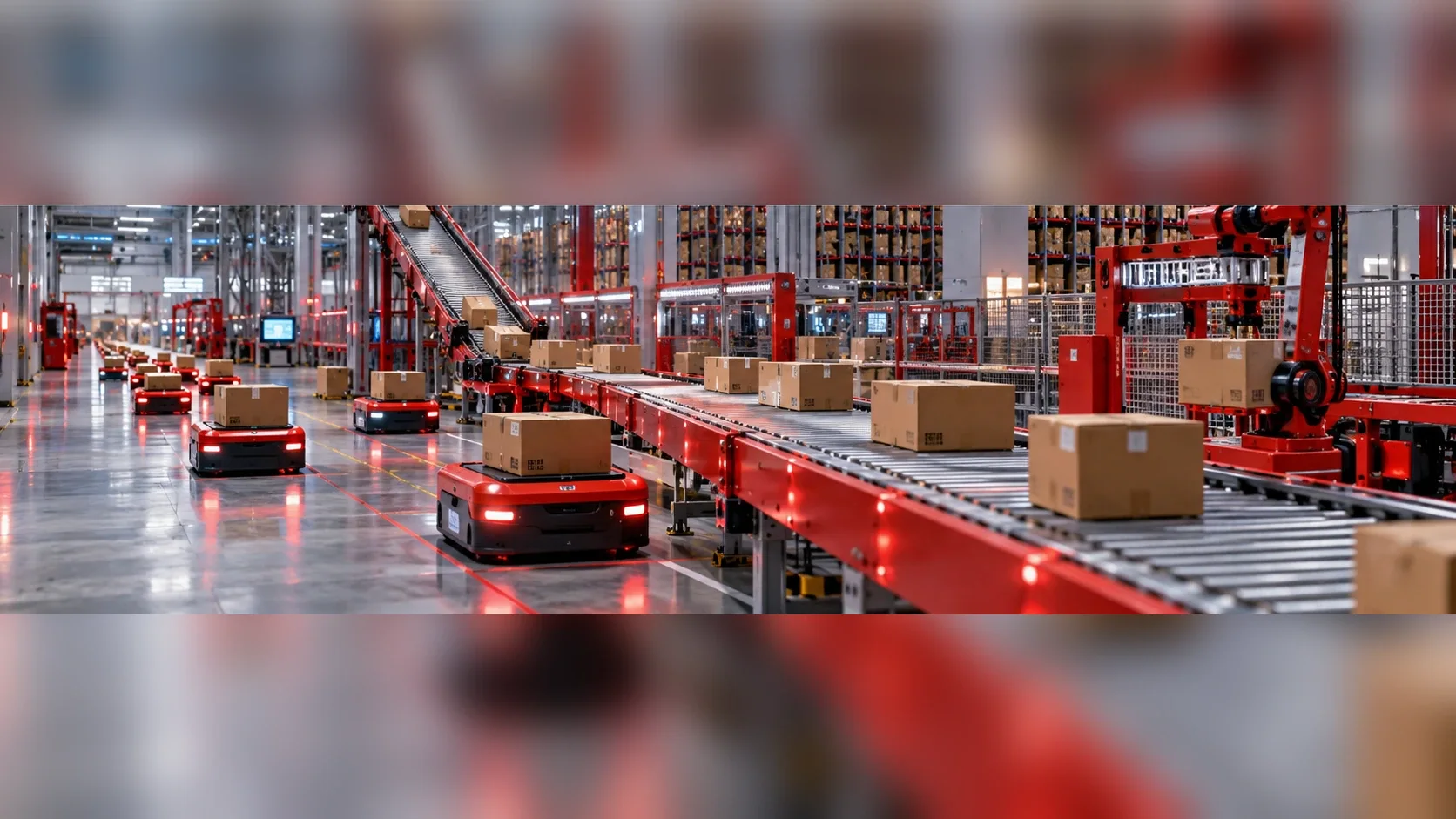
One reason JD’s logistics network interests me is that it can become more valuable as robotics improve. Automated sorting, autonomous warehouse movement, demand forecasting and route optimization can reduce labor intensity per order.
The physical network has already been built. The next phase is making it smarter.
This is a different AI story from Baidu. Baidu sells infrastructure and models. JD uses technology to improve the economics of moving goods. For investors who want China technology exposure without paying primarily for model leadership, that distinction is useful.
The Chinese consumer remains the macro risk
JD cannot escape the broader economy. Weak property markets, cautious households and intense promotional competition can reduce discretionary spending and put pressure on prices.
The company’s strength in appliances and electronics means government trade-in subsidies can materially affect demand. That can help near-term revenue but also create difficult comparisons later. Investors should therefore distinguish between structural user growth and policy-supported spending.
The Q2 revenue decline partly reflects a high base. That is not automatically a deterioration in the franchise, but it means growth should be judged over several quarters.
At $27, the valuation reflects a lot of pessimism
JD traded near $27 on September 10, with a market capitalization around $36 billion. StockAnalysis estimated enterprise value near $13.5 billion, reflecting the company’s substantial net cash and investments.
That is a remarkable valuation relative to the scale of the business. It does not mean the stock is automatically cheap. Retailers with low margins can generate huge revenue and still deserve modest equity values. The more relevant comparison is to normalized earnings and free cash flow.
But JD’s valuation creates asymmetry if margins stabilize. The company does not need a dramatic revenue acceleration for earnings to grow. It needs the drag from food delivery and newer initiatives to shrink while JD Retail remains healthy.
Why margin normalization matters more than revenue growth
Imagine consolidated revenue barely grows, but JD Retail sustains a margin around 5%, service revenue increases faster than product revenue and new-business losses decline. In that environment, operating profit can grow meaningfully without a top-line boom.
That is the core rerating thesis.
Investors often pay attention to gross merchandise volume or revenue because those numbers are easy to compare. At this stage of JD’s development, I care more about incremental margin: how much additional operating profit is created from each additional renminbi of revenue.
Three scenarios for JD.com
| Scenario | Core retail | New businesses | Valuation implication |
|---|---|---|---|
| Bear | Margin slips below 4% | Losses remain high | Low multiple remains justified |
| Base | Margin stays around 4.5–5.5% | Losses narrow steadily | Earnings recover even with modest revenue growth |
| Bull | Margin expands above 5% | Food delivery approaches breakeven | Market begins valuing logistics and services separately |
The base case is not heroic. It assumes JD Retail remains disciplined and newer initiatives become less expensive over time. That alone could produce a much better consolidated earnings profile.
Competition is not going away
JD competes with Alibaba, PDD Holdings, Meituan, Douyin and a wide range of vertical platforms. Each competitor attacks a different part of the value proposition: price, entertainment, delivery speed, marketplace breadth or local services.
JD’s response is trust, fulfillment quality and supply-chain integration. That is a real differentiation, but it can be expensive to maintain.
PDD is particularly important because aggressive value positioning can pressure pricing across Chinese e-commerce. JD should not chase every low-price transaction if doing so damages margin and brand trust.
Why JD’s balance sheet matters
A strong balance sheet gives management room to invest through periods of competition. It also supports buybacks and strategic expansion.
However, cash should not be treated as automatically worth one dollar per dollar if management repeatedly deploys it into low-return projects. The food-delivery push is therefore a capital-allocation test as much as an operating strategy.
If losses narrow as promised and user engagement improves, the investment may prove rational. If subsidies become permanent, the cash balance becomes less reassuring.
What would make me more bullish?
First, I would want JD Retail operating margin to remain above roughly 4.5% through a full competitive cycle. Second, food-delivery losses should continue narrowing. Third, service revenue should maintain double-digit or high-single-digit growth. Fourth, fulfillment expense as a percentage of revenue should eventually stabilize as order density improves. Fifth, free cash flow should remain strong enough to support both investment and shareholder returns.
If those conditions are met, the current valuation would look increasingly difficult to justify.
What would break the thesis?
The biggest risk would be a return to permanent subsidy warfare. If instant retail forces JD to spend heavily for years while competitors respond with equal intensity, the new business could consume much of the profit generated by core retail.
A second risk is margin compression in JD Retail itself. If the core engine weakens at the same time new businesses remain unprofitable, the earnings base becomes far less attractive.
A third risk is macroeconomic. Persistent consumer weakness can limit demand and intensify price competition across the sector.
How JD differs from Costco
Our Costco deep dive highlights a retailer whose moat comes from membership economics, extreme inventory discipline and customer loyalty. JD’s moat is different. It is built around logistics density, delivery reliability, procurement scale and digital infrastructure.
Both businesses demonstrate an important lesson: retail margins can look small while the underlying system is extremely valuable. The key is consistency and capital efficiency, not headline percentage margins.
JD.com as a China infrastructure bet
I think the most useful way to view JD is not as an online store but as commerce infrastructure. It connects suppliers, warehouses, couriers, merchants and consumers through a network that has taken years and enormous capital to build.
That network becomes more valuable if it supports more external merchants, more service revenue and more daily-use categories. It becomes less valuable if competition forces JD to subsidize every transaction.
That distinction should drive the valuation.
My view on JD stock
At around $27, JD.com is priced like a business whose best days may already be behind it. The Q2 numbers do not support that conclusion cleanly. Revenue declined, yes, but operating profit recovered sharply, retail margins remained healthy and service revenue continued growing.
The company is spending heavily on fulfillment, technology and local commerce. Those investments are depressing near-term economics. The crucial question is whether they create a denser, more frequently used ecosystem or simply open another front in China’s subsidy wars.
I lean toward a cautiously positive interpretation because the core JD Retail business remains profitable and because Q2 showed clear improvement in consolidated profit. But I would not call the stock a simple bargain. The low valuation exists for a reason: investors distrust capital allocation and fear competition.
If management proves that food-delivery losses can keep narrowing while retail margins stay above the mid-4% range, the earnings recovery could be much stronger than the revenue line suggests. In that scenario, investors may begin to recognize that JD’s logistics machine is not merely a cost center. It is an asset.
And if that happens, $36 billion of equity value may eventually look less like a fair price for a retailer and more like a discount for one of China’s most important commerce infrastructure platforms.
Sources
- JD.com Investor Relations — Q2 and Interim 2026 Results
- JD.com Investor Relations — Q1 2026 Results
- JD.com Investor Relations — Annual Reports
- StockAnalysis — JD.com market capitalization and enterprise value
This article is independent analysis, not investment advice. Valuation scenarios are illustrative and not price targets.