
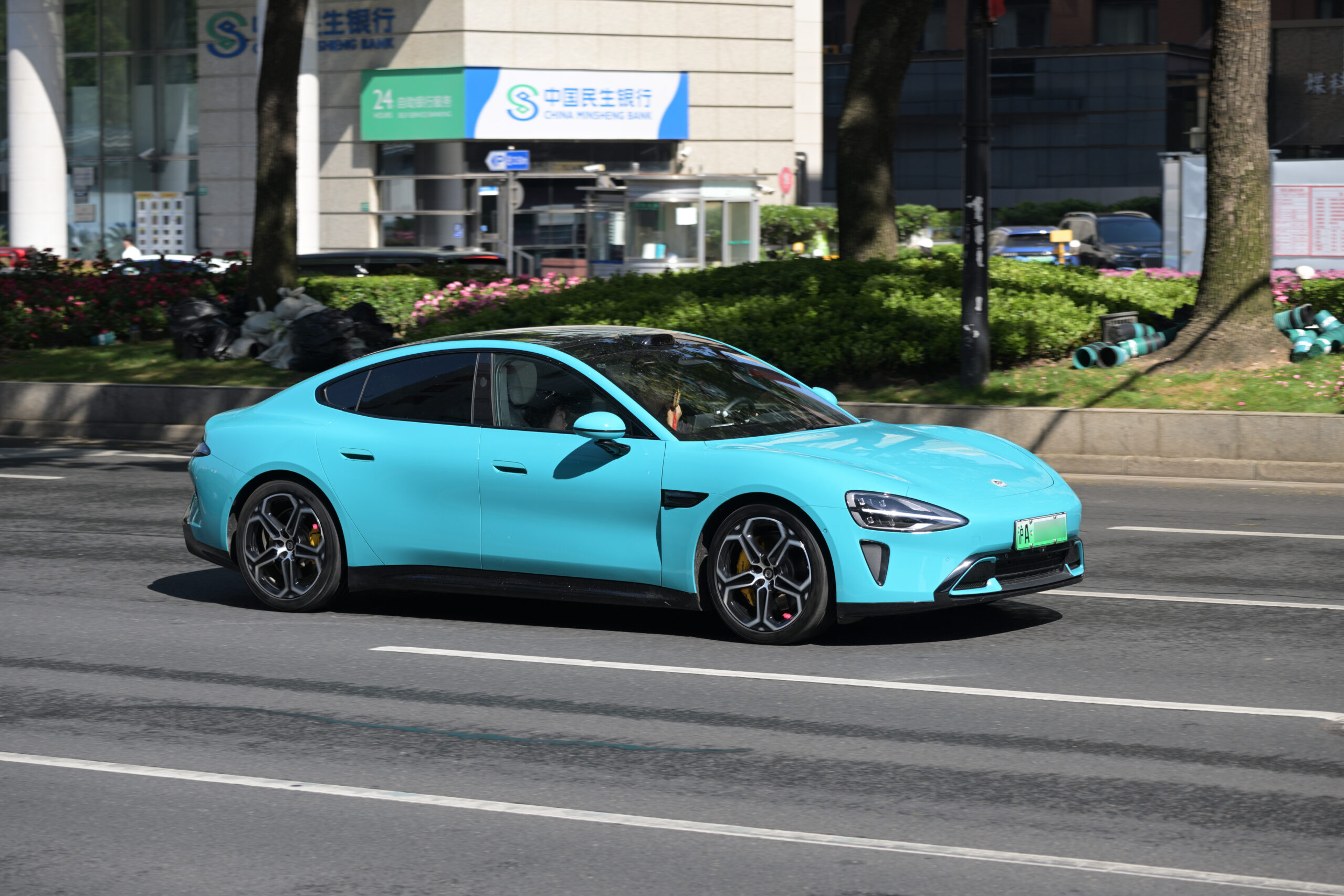
Data as of September 11, 2026. Xiaomi is no longer easy to describe. It is still one of the world’s largest smartphone makers, but it is also becoming an electric-vehicle manufacturer, an AI platform, a connected-device ecosystem and, increasingly, a company whose future economics may look very different from its past.
That tension was visible in the second quarter of 2026. Group revenue fell 6.1% year over year to RMB108.9 billion, while adjusted net profit dropped 42.6% to RMB6.2 billion. Smartphone shipments fell 26.5% to 31.2 million units. Yet the EV business delivered 104,199 vehicles, up 28.2%, and the Smart EV, AI and other new initiatives segment generated RMB24.9 billion of revenue with a gross margin of 19.2%.
Those numbers tell two different stories at once. The legacy engine is under pressure from memory costs, competition and weaker unit volumes. The new engine is scaling quickly enough to matter. The central investment question is therefore no longer whether Xiaomi can build cars. It clearly can. The question is whether the company can turn its Human × Car × Home ecosystem into a business model where higher-value devices, software, services and vehicles offset the volatility of the smartphone cycle.
Xiaomi’s Q2 was weaker than the headline story suggests
Investors who only look at EV growth could easily miss the deterioration in the rest of the group. Second-quarter revenue was RMB108.9 billion, down from RMB116.0 billion a year earlier. Gross margin fell to 19.8% from 22.5%. Adjusted net profit fell to RMB6.2 billion from RMB10.8 billion.
The first-half comparison is even harsher. Revenue declined 8.4% year over year to RMB208.1 billion, operating profit fell 39.1%, and adjusted net profit dropped 42.8%.
This is not a small cyclical wobble. It is a reminder that Xiaomi’s hardware business remains exposed to component prices and competitive intensity. Memory costs rose sharply, and the company spent more aggressively on research, AI and automotive development at the same time.
That does not make the long-term thesis wrong. But it changes the standard of proof. EV growth now has to become large enough, profitable enough and strategically connected enough to justify the pressure on the core.
The smartphone business is trading volume for premiumization
Xiaomi shipped 31.2 million smartphones in Q2, down 26.5% year over year. That is a dramatic unit decline for a company that still ranks among the top three global smartphone vendors.
But average selling price moved in the opposite direction. Smartphone ASP reached RMB1,351, up roughly 26% year over year. Premium models represented 32.1% of smartphone sales in mainland China according to Xiaomi’s presentation.
This is the strategic trade-off. Xiaomi historically built scale by selling capable phones at aggressive prices. That created users, but it did not always create premium margins. Moving upmarket can lift revenue per device, improve brand economics and support higher service monetization — but only if unit losses are controlled.
In Q2, premiumization did not fully offset the volume decline. Smartphone revenue still fell. That is why I would watch unit stabilization more closely than the ASP headline from here.
The EV business is now too large to call an experiment
The automotive business is different. Xiaomi delivered 104,199 vehicles in Q2 2026, up 28.2% year over year. Revenue from Smart EV, AI and other new initiatives reached RMB24.9 billion, up from RMB21.3 billion a year earlier.
That means nearly 23% of Xiaomi’s quarterly revenue now comes from the new segment. Two years ago, investors could reasonably treat the car business as an option. Today it is becoming a core operating segment.
Even more important is the gross margin. The segment delivered 19.2% gross margin in Q2. For a young EV operation still absorbing factory ramp costs, product launches and ecosystem investments, that is a respectable level.
Why the 19.2% EV segment gross margin matters
The electric-vehicle industry has taught investors a painful lesson: revenue growth is not the same thing as economic value. Plenty of EV companies can sell more cars by cutting prices. The harder task is generating a margin that eventually covers R&D, factories, sales infrastructure and capital costs.
Xiaomi’s 19.2% gross margin in Smart EV, AI and other new initiatives suggests the business is not merely buying volume at any price. The figure still includes more than just vehicles, so it should not be treated as a pure automotive margin. But it is strong enough to make the segment financially relevant rather than purely strategic.
The next test is operating leverage. A gross margin can look healthy while the segment still loses money after R&D and selling expenses. As volumes rise, Xiaomi needs fixed engineering and manufacturing costs to spread across more vehicles.
The car is not separate from the smartphone thesis
The most interesting part of Xiaomi’s strategy is that the EV is not intended to be a standalone automotive business. The company’s entire product architecture is built around Human × Car × Home.
That phrase can sound like marketing, but the underlying economics are meaningful. A Xiaomi user may own a phone, tablet, television, smartwatch, air purifier, router and car. If those devices share software, identity, payments, AI assistants and data, switching becomes more inconvenient.
The goal is not Apple-style lock-in in the strict sense. Xiaomi has always competed more aggressively on price and openness. But even partial ecosystem stickiness can raise lifetime customer value.
A vehicle is particularly powerful because it is the highest-ticket product most consumers buy after a home. If Xiaomi can connect the car to the rest of its installed base, the company gains another daily interface with the user.
1.16 billion connected IoT devices is the hidden scale asset
As of June 30, Xiaomi reported 1.1608 billion connected IoT devices on its AIoT platform, excluding smartphones and tablets. That was up 17.4% year over year. Global monthly active users reached 766.5 million, up 4.8%.
These numbers matter because hardware alone tends to deserve low multiples. Hardware plus a large recurring-services layer can deserve something very different.
The internet-services business illustrates the opportunity. It generated RMB9.0 billion of revenue in Q2 with a gross margin around 76.8%. The segment is much smaller than hardware, but its economics are dramatically better.
Every incremental improvement in monetization across hundreds of millions of users can matter more to long-term valuation than another few million low-margin phone units.
AI can improve both the product and the cost structure
Xiaomi increased R&D expense 18.9% year over year to RMB9.2 billion in Q2. Nearly half of employees were classified as R&D personnel by midyear.
This spending is aimed at AI, operating systems, chips, robotics, automotive technologies and foundational research. The company increasingly wants to own more of the intelligence layer across its devices rather than simply integrating third-party services.
The bullish case is straightforward: AI makes the phone, car and home ecosystem more useful while also improving manufacturing, customer service, software development and supply-chain planning.
The bearish case is equally clear: Xiaomi is now funding several capital-hungry technology fronts at once. If AI investment grows faster than monetization, it can become another cost center layered on top of automotive expansion.
The memory-cost problem is a reminder of Xiaomi’s old weakness
One of the biggest Q2 headwinds was component inflation, particularly memory. This matters because smartphones remain a competitive hardware category with limited pricing power in many markets.
Xiaomi can raise ASP through premiumization, but it cannot simply pass every component increase to consumers without risking volume. That is exactly why the ecosystem shift matters. The more gross profit comes from services, software and higher-value products, the less vulnerable Xiaomi becomes to memory cycles.
For now, however, the exposure remains real. Investors should not treat the smartphone business as a stable cash cow.
How Xiaomi compares with BYD
Our BYD stock analysis describes an automotive company built around batteries, manufacturing scale and vertical integration. Xiaomi’s automotive advantage is different. It starts with consumer electronics, software distribution and an existing digital user base.
BYD is trying to make cars smarter. Xiaomi is trying to make its ecosystem include a car.
That difference has valuation consequences. If Xiaomi’s EV business succeeds, the company may deserve neither a traditional handset multiple nor a traditional automaker multiple. It becomes a hybrid platform whose economics depend on cross-selling and user retention.
Tesla is the more useful strategic comparison
Our Tesla analysis highlights the market’s willingness to pay for optionality beyond car manufacturing. Tesla is valued partly on autonomy, software, energy and robotics rather than vehicle earnings alone.
Xiaomi is not Tesla. Its brand, geographic exposure, software model and regulatory environment are different. But the comparison shows why investors may eventually value a vehicle as one node in a broader technology ecosystem.
The danger is that narrative can outrun economics. Xiaomi must prove the vehicle business creates attractive returns, not just strategic excitement.
What the current stock price implies
Xiaomi’s Hong Kong shares closed around HK$26.92 on September 8 according to the company’s historical price data. The company’s U.S. OTC market capitalization was roughly $71 billion around September 9.
That is not a trivial valuation, but it is also not enormous for a company with more than RMB400 billion of annualized revenue capacity, a global smartphone franchise, a fast-scaling EV segment and hundreds of millions of active users.
The issue is earnings quality. Adjusted profit is falling while capital intensity is rising. A low revenue multiple does not make a stock cheap if margins structurally deteriorate.
I would therefore value Xiaomi using a sum-of-the-parts mindset rather than a single P/E ratio.
A sum-of-the-parts framework makes more sense
The smartphone and AIoT business deserves one multiple because it is mature, competitive and hardware-heavy. Internet services deserve a higher multiple because margins are high and revenue is recurring. EV and AI initiatives deserve a growth multiple, but discounted for execution risk and capital needs.
The challenge is that these pieces are tightly integrated. That creates strategic value but makes accounting separation harder.
A useful mental model is to ask what happens if the EV segment reaches scale without destroying group margins. In that case, the market may begin valuing Xiaomi less like a handset maker and more like a diversified technology platform.
Three scenarios for Xiaomi stock
| Scenario | Smartphones | EV business | Implication |
|---|---|---|---|
| Bear | Volumes keep falling | Margins compress | Higher capex, lower group earnings |
| Base | Units stabilize, ASP stays higher | Deliveries grow with ~high-teens gross margin | Earnings recover gradually |
| Bull | Premium share expands | Strong scale and operating leverage | Platform-style rerating becomes possible |
The base case does not require explosive smartphone growth. It only requires stabilization. The EV business can then become the incremental growth engine while services lift mix quality.
What would make me more bullish?
First, smartphone shipments need to stabilize after the 26.5% Q2 decline. Second, the EV and new-initiatives gross margin should remain near the high teens as deliveries scale. Third, internet-services revenue should continue growing without sacrificing its high margin. Fourth, R&D growth needs to produce visible product differentiation rather than permanent margin dilution.
Most importantly, Xiaomi should show that consolidated adjusted profit can recover even while the EV business continues expanding. That would prove the company is moving from investment phase to operating leverage.
What would break the thesis?
The biggest risk is simultaneous pressure in both major engines. If smartphone volumes continue falling while EV margins decline because of Chinese price competition, Xiaomi could end up funding two difficult hardware cycles at once.
A second risk is capital allocation. Automotive manufacturing requires factories, tooling, service networks and working capital. The business can absorb enormous cash before returns become clear.
A third risk is geopolitics. Xiaomi sells globally and depends on complex semiconductor and component supply chains. Trade restrictions, tariffs or technology controls could affect either devices or vehicles.
Why the next twelve months matter more than the last twelve
The market already knows Xiaomi can build a successful first-generation EV. The more important question is whether the company can create a durable automotive franchise across multiple models while protecting the economics of the rest of the group.
2027 will also become strategically important because Xiaomi has discussed international automotive expansion. Exporting vehicles introduces new homologation, distribution, tariff and service challenges. It also expands the addressable market enormously.
If Xiaomi can move from a China-only EV story to a global one, the valuation framework changes again.
My view on Xiaomi stock
Xiaomi’s Q2 2026 report was not a clean beat. It was a warning wrapped around a promising transition. The smartphone business weakened materially, component costs hurt profitability and adjusted earnings fell sharply.
But the EV operation is no longer a concept. More than 104,000 quarterly deliveries, RMB24.9 billion of segment revenue and a 19.2% gross margin prove that Xiaomi has built a second large business with real economic weight.
The investment case therefore comes down to whether the company can cross the bridge between these two eras. The old Xiaomi won by shipping affordable electronics at huge scale. The next Xiaomi wants to win by connecting phones, homes, cars and AI into one ecosystem.
I think that ambition is credible enough to deserve attention, but not yet proven enough to ignore the earnings decline. At today’s valuation, I would not buy the stock simply because EV deliveries are growing. I would buy it only if I believed EV scale, premiumization and services can eventually push group profit growth back above revenue growth.
If that happens, Xiaomi may become one of the rare companies to successfully evolve from a hardware brand into a multi-device platform. If it does not, investors may discover that building a car company on top of a smartphone company is an extraordinarily expensive way to chase growth.
Sources
- Xiaomi — Q2 2026 Results Announcement
- Xiaomi — Q2 2026 Results Presentation
- Xiaomi Investor Relations — Quarterly Results
- Xiaomi Investor Relations — Historical Price Data
This article is independent analysis, not investment advice. Scenario analysis is illustrative and not a price target.